
Reviewed · WALKING TOURS
LocalPlaces Understanding Johannesburg Walking Tour
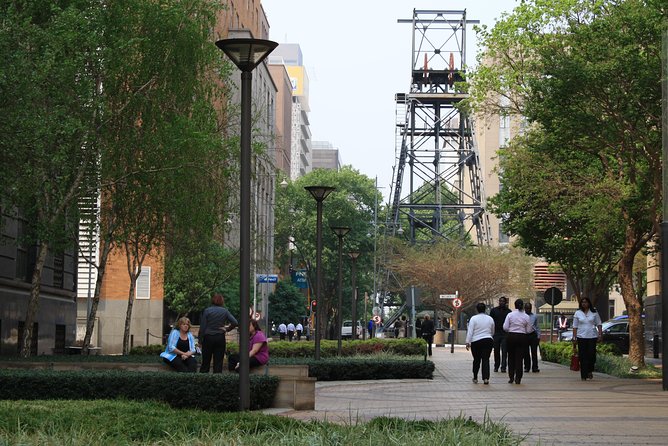
Johannesburg’s past is written into its streets, and this tour reads those layers one by one. You begin with the gold rush, walk through the old financial district, and reach today’s coffee shops and eateries on Main Street. Charlie’s storytelling and the chance to see an abandoned stock exchange with stained glass windows give the walk unusual character.
I like the clear beginning-to-present-day story, and I like that the tour includes real places tied to Gandhi, Mandela, and Tambo rather than relying only on general city commentary. The main consideration is that this is a four-hour walking tour in the inner city, so it suits you best if you are comfortable being on foot and want history more than a quick sightseeing loop.
Key points to know before booking
- A full Johannesburg story: Follow the city from pre-gold rush days through mining wealth, decline, and current renewal.
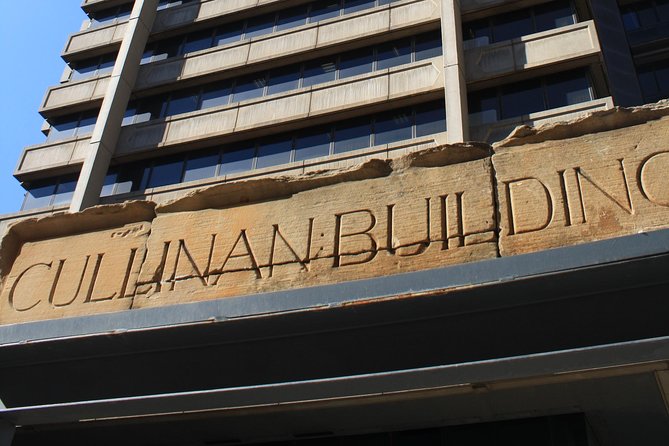
- Marshalltown at the center: Explore the oldest part of the inner city, where mining and financial firms first took root.
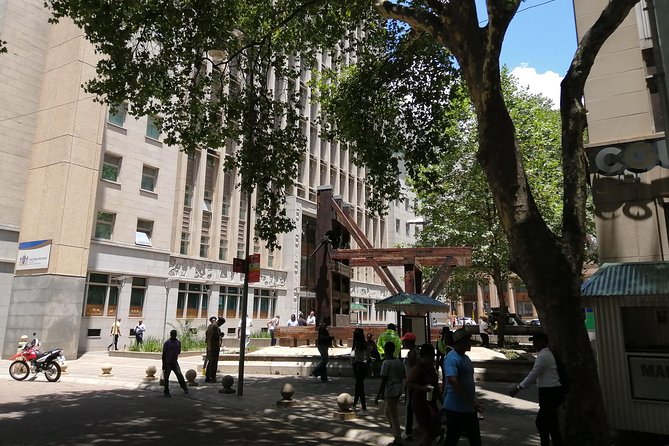
- Gandhi Square connection: See the sculpture of Gandhi as a young lawyer and learn about his work in Johannesburg.
- Architecture with access: The walk includes historic buildings and, when available, an abandoned stock exchange with stained glass windows.
- Private format: Only your group participates, which makes it easier to ask questions and set the pace within the tour plan.
- Four hours at 9:00 a.m.: The morning timing leaves much of the afternoon free, but you should arrive ready for a substantial city walk.
Why this is a useful first look at Johannesburg
Johannesburg can be hard to read on your own. Its grand old buildings, newer shops, vacant spaces, and busy streets do not always explain themselves. This walk gives you the missing thread: gold created the city, money shaped its center, social and political change altered it, and new businesses are helping parts of the inner city find a fresh role.
That makes the tour a good opening activity for a Johannesburg visit. Instead of seeing isolated buildings, you connect them to the city’s economic rise and fall. I especially like this approach because it treats Johannesburg as a living place, not simply as a backdrop for famous people or major events.
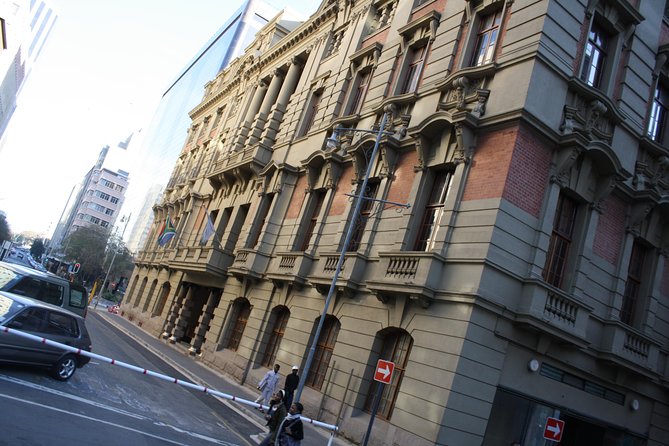
The route focuses on the Wiser West, the older western part of the central business district. The area is known for its architectural character and its links to early mining and finance. You will see the city’s Edwardian period, which refers to the early 1900s, alongside signs of later decline and current efforts to bring streets and buildings back into use.
The tone is meant to be lively rather than academic. Charlie is identified as the guide, and his storytelling is a major part of the experience. If you enjoy a guide who connects buildings to people and events, this should suit you. If you prefer a fast route with little explanation, four hours may feel long.
More Walking Tours in Johannesburg
- Soweto: Walking Tour with a Local Guide and Lunch
★ 4.9 · 648 reviews - Soweto Walking Tour with Lunch
★ 5.0 · 288 reviews - Johannesburg: Local Food Tasting Guided Walking Tour
★ 4.7 · 192 reviews
Starting at Pritchard Street and Gandhi Square
The tour begins at 2 Pritchard Street at 9:00 a.m. It ends back at the same meeting point, which is handy if you are planning lunch or another activity afterward. The morning start also gives you a clear first block of sightseeing before the rest of your day begins.
The opening section sets up Johannesburg before and during the gold rush. That context matters because the city’s central streets were not planned as an old colonial capital in the usual sense. Their identity grew quickly around mining, trade, companies, and the people drawn by the promise of gold.
Gandhi Square is an important first stop. You see a sculpture of Gandhi as a young lawyer, and the guide explains that he worked there as a business lawyer. This is a useful correction to the way Gandhi is often presented only through his later political life. Here, he appears in an earlier chapter, before he became the figure known around the world.
The square also gives you a place to understand the city’s changing public spaces. It is not just a point for a photograph. It links Johannesburg’s legal and commercial past with the civic memory preserved in the present.
The Gandhi Square portion lasts about 15 minutes, while the broader Marshalltown walk takes roughly three hours. That balance tells you what to expect. Gandhi Square is a focused stop, but most of the tour is spent moving through streets and buildings while the wider story unfolds.
Walking through Marshalltown’s mining district
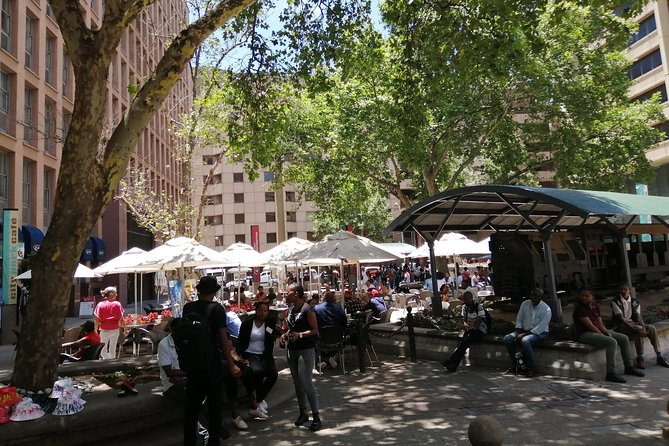
Marshalltown is the heart of the experience. This older section of the central business district is where Johannesburg’s mining and financial companies established themselves. Its buildings help show how quickly the gold rush changed the city and how wealth was expressed in offices, banks, streets, and public architecture.
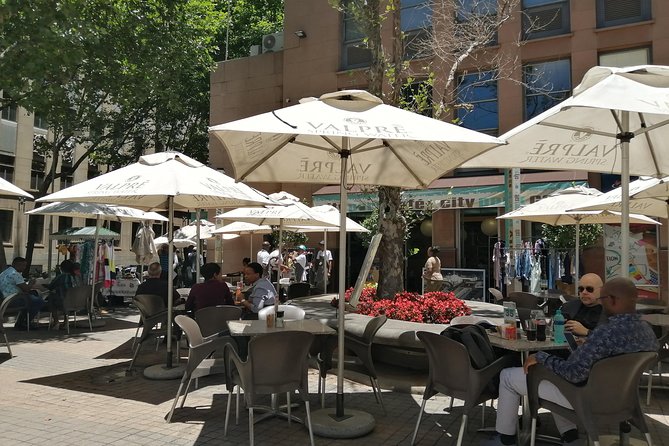
I would pay close attention to the contrast between the scale of the old buildings and the current street scene. The Edwardian period brought a polished, confident style to the center. Later, economic and social shifts left some buildings underused or abandoned. Today, parts of the district are being used again by coffee shops, eateries, and other businesses.
That contrast is one of the tour’s strongest features. You are not given a cleaned-up version of the city. You see the grand ambition of the early center, the difficult period that followed, and the signs of repair and reuse now taking shape. For anyone interested in city planning, architecture, or urban change, this is more useful than a standard list of landmarks.
Main Street is especially important. The pedestrianised section runs through the corporate mining district and brings together historic sites with newer activity. As you walk, the street becomes a kind of timeline. The older buildings explain the city’s original power, while the current cafés and food spots show how people are giving the district a different daily purpose.
The walking route also helps with scale. Johannesburg’s story is often told through large events, but this tour brings those events down to street level. Company offices, courts, sculptures, and old exchanges become evidence of how the city worked.
The abandoned stock exchange and old interiors
One of the most memorable details connected with this walk is the chance to go inside an abandoned stock exchange with stained glass windows. Access to historic interiors can make a major difference. A building that seems quiet or worn from the outside can reveal the confidence and ceremony of an earlier financial age once you see its interior.
The stock exchange is a particularly good setting for the gold rush and mining story. Financial institutions were not separate from Johannesburg’s growth. They helped organize the money that mining created and reflected the importance of the companies based in the district.
The stained glass is also a reminder that practical business buildings were designed to make an impression. These were places where wealth, authority, and permanence mattered. Seeing those details in an abandoned setting adds a sharp sense of change. You can compare the building’s original purpose with its later neglect without needing a long lecture about urban decline.
Because access to old buildings can depend on conditions on the day, you should treat the interior visit as part of the walking experience rather than the only reason to book. Still, it is an unusual feature and one of the clearest examples of how the tour moves beyond street-level commentary.
A different side of Johannesburg altogether:
- From Johannesburg: Pilanesberg Nature Reserve Game Safari
★ 4.8 · 1,327 reviews - Johannesburg: Hop-On Hop-Off Bus with Optional Soweto Tour
★ 4.6 · 985 reviews - Soweto /Johannesburg and Apartheid Museum Guided Full Day Tour
★ 5.0 · 932 reviews - Johannesburg Hop-On Hop-Off City Tour with Soweto Option
★ 4.5 · 768 reviews
Mandela, Tambo, and Johannesburg’s legal past
The walk also includes the Shadow Boxer sculpture, located near the former offices of Mandela and Tambo. That connection gives the tour another angle on the city. Johannesburg was not only shaped by mining companies and financial firms. It was also a place where legal work, political ideas, and resistance developed.
The sculpture helps place Mandela and Tambo within the physical city. You are not simply hearing their names in a distant historical account. You are shown where their professional lives were tied to the central business district.
This is one reason the tour works well for first-time visitors. It links separate parts of Johannesburg’s story: gold, business, law, race, politics, and regeneration. You get a sense of how the same streets served different purposes as the city changed.
The tour does not appear to be designed as a dedicated apartheid-history walk, so you should not book it expecting every major site connected with that subject. Its strength is the broad arc, from the city’s origins to the present. The Mandela and Tambo stop adds political weight without taking the entire walk away from its architectural and economic focus.
From glory days to decline and renewal
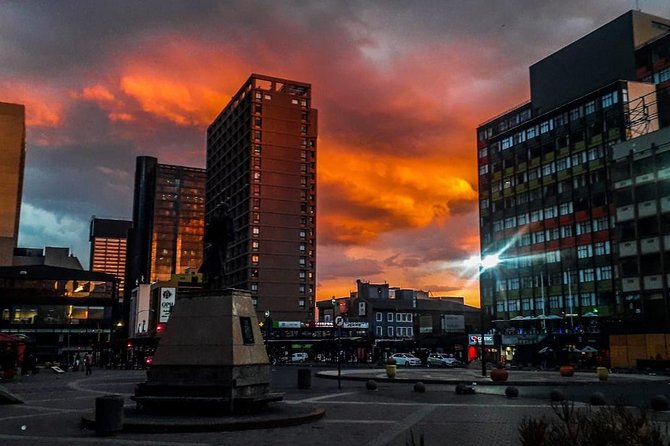
The most honest part of the route is its treatment of decline. Johannesburg’s center once represented power and prosperity, but parts of the inner city later suffered from neglect and loss of investment. This tour includes that difficult chapter instead of presenting only the city’s early success.
That matters because current regeneration makes more sense when you know what came before. A new café on Main Street is not just a convenient place to stop. It may be part of a broader attempt to bring people, work, and daily life back into an older district.
You may find the mix of renovated areas, historic façades, and underused buildings visually striking. It can also feel uneven. Regeneration rarely happens all at once, and a walking tour through a changing city may show both promise and problems in the same few blocks.
I see that as a benefit for the right kind of visitor. You get a more realistic view of Johannesburg than a tour that shows only polished attractions. At the same time, you should be prepared for a city center with visible contrasts and an urban feel that can change from street to street.
What four hours on foot means
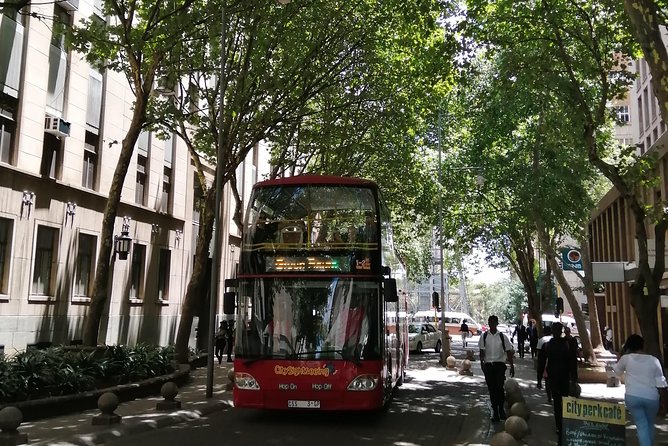
The stated duration is about four hours, with around three hours devoted to Marshalltown and a shorter Gandhi Square stop. This is long enough to build a serious story, but it is not a quick orientation walk. Wear comfortable shoes and plan to stay engaged as the guide moves between locations.
The tour begins at 9:00 a.m. That timing is practical if you want to use the afternoon for another activity. It also means you should not schedule something immediately after the walk unless you allow extra time. The tour ends at the starting point, but the exact finish can vary with the pace of the group and the conditions of the walk.
This is a private activity, so only your group participates. That can be a real advantage. You can ask about a building that catches your eye, request more explanation about a historical figure, or pause to take in an architectural detail without competing with a large group.
Private tours also cost more than shared walks, and the price here is $80.80 per person. I think the value depends on how much you want from the guide. For a person mainly looking for a few photographs, it may feel expensive. For someone who wants a carefully connected account of Johannesburg, access to distinctive old spaces, and the freedom of a private group, the price is easier to justify.
Group discounts may reduce the cost for larger parties. Since the tour is usually booked about 15 days ahead, it is sensible to reserve early if your dates are fixed.
Who will enjoy this Johannesburg walk
I would recommend this experience to you if you like:
- Architecture from the gold rush and Edwardian periods
- City history told through streets and buildings
- The links between mining, finance, law, and politics
- Honest discussion of urban decline and renewal
- Private tours where you can ask questions
- A substantial morning walk rather than a short photo stop
It is also a strong choice if this is your first introduction to central Johannesburg. The tour gives you useful background before you visit other parts of the city.
You may want a different activity if you are seeking a museum-based visit, a dedicated apartheid tour, or a short route with little walking. The focus here is the central city and its changing built environment. Its appeal comes from interpretation and observation, not from a long list of formal attractions with timed entries.
Most people can participate, and service animals are allowed. The tour is near public transportation, but the supplied details do not specify a particular station or route, so confirm your approach before the morning. Since good weather is required, keep some flexibility in your schedule.
Booking, weather, and cancellation details
Confirmation is provided when you book, and the tour offers mobile tickets. You can cancel for a full refund up to 24 hours before the start time. Changes or cancellations made inside that 24-hour window are not accepted for a refund.
Poor weather can lead to a new date or a full refund. The tour also requires a minimum number of participants, so if that minimum is not reached, you will be offered another date or experience, or a full refund.
Those terms are fair for an outdoor walking activity, but I would avoid placing it on the one morning when your schedule has no room for a change. The 24-hour cut-off is based on local time in Johannesburg.
Should you book the LocalPlaces Understanding Johannesburg Walking Tour?
Book it if you want Johannesburg explained through its oldest central streets, and if you are willing to spend four hours walking, listening, and looking closely. The best reasons are the broad city story, Marshalltown’s architecture, the Gandhi and Mandela connections, and the unusual stock exchange interior.
At $80.80 per person, it is not a bargain-priced orientation stroll. The private format and Charlie’s storytelling make the cost more reasonable for a couple, family, or small group that values personal attention. I would choose it near the start of a Johannesburg stay, when the wider context can improve everything else you see afterward.
FAQ
Where does the tour start?
It starts at 2 Pritchard Street, Johannesburg, 2113, South Africa.
What time does the tour begin?
The tour starts at 9:00 a.m.
Where does the tour end?
The activity ends back at the meeting point on 2 Pritchard Street.
How long does the tour last?
The tour lasts approximately four hours.
How much does the tour cost?
The listed price is $80.80 per person. Group discounts are available.
Is this a private tour?
Yes. Only your group participates in the activity.
What areas does the tour visit?
The main focus is Marshalltown, including the older Johannesburg central business district, Gandhi Square, and the pedestrianised section of Main Street.
Can I cancel for a full refund?
Yes. You can cancel at least 24 hours before the experience start time for a full refund.
What happens if the weather is poor or the minimum number of participants is not reached?
If poor weather cancels the tour, you will be offered a different date or a full refund. If the minimum number of participants is not met, you will be offered a different date or experience, or a full refund.
Just listed around Johannesburg
- Constitutional Hill and Soweto 5 hours tour.★ 5.0 · 5 reviews
- 5 Day Kruger Glamping Safari and Panorama Tour★ 5.0 · 5 reviews
- Cradle of Humankind and Maropeng Day Tour from Johannesburg★ 4.0 · 5 reviews
- Johannesburg: Hot Air Balloon Flight★ 5.0 · 5 reviews
- Half Day Soweto and Apartheid Museum Guided Tour★ 5.0 · 5 reviews
- Lion park★ 4.5 · 5 reviews
- 5 Day Kruger National Park and Panorama Route Safari★ 4.5 · 5 reviews
- Pretoria Historical Tour★ 4.0 · 5 reviews
Walking Tours, compared.





Browse the lists this tour appears in