
Reviewed · WALKING TOURS
Johannesburg’s Downtown Walking Tour with lunch
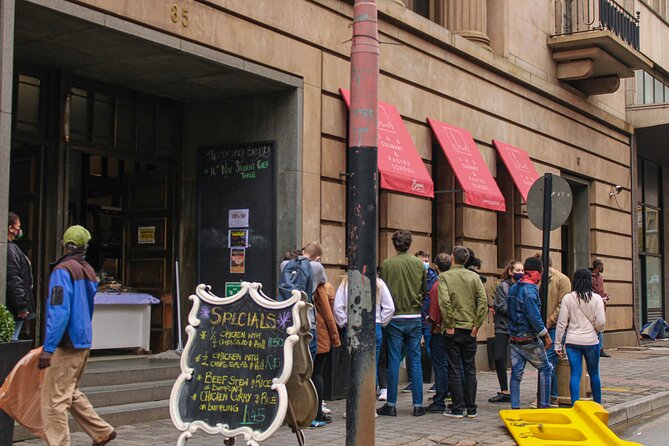
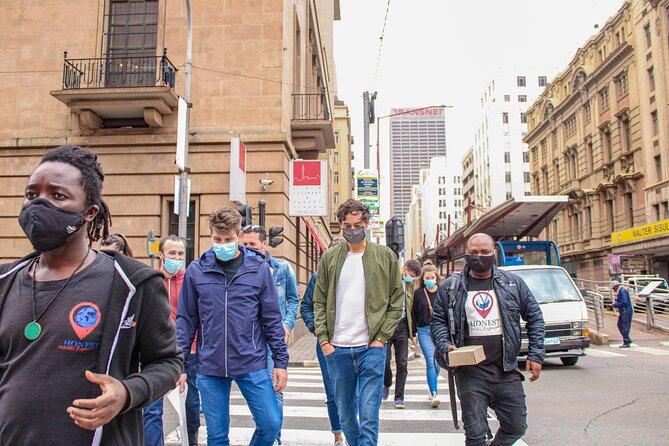
Johannesburg makes the most sense when someone explains the forces behind its sharp changes. This tour takes you through Braamfontein, Newtown, and Gandhi Square, linking apartheid, migration, business, art, and the city’s present-day struggles instead of showing you only polished attractions. Guides such as Sean, Nkosi, Tigh, and Romeo have led this route, and the guide you receive can shape the experience.
I like two things right away: the walking format gets you close to street life, and lunch gives the three-to-five-hour outing a useful pause rather than making it a string of drive-by photo stops. I also like the plainspoken approach to safety. You are not told to ignore Johannesburg’s problems, but you are given context for how they developed.
The trade-off is that this is not a gentle sightseeing stroll through uniformly comfortable streets. Some areas may feel uneasy, and the route can expose you to poverty, litter, and visible urban decline. The guide is there to help you move confidently, but you still need normal city awareness and comfortable walking shoes.
Key points at a glance
- Johannesburg explained street by street: Guides connect buildings, bridges, plazas, and neighborhoods to the city’s political and economic changes.
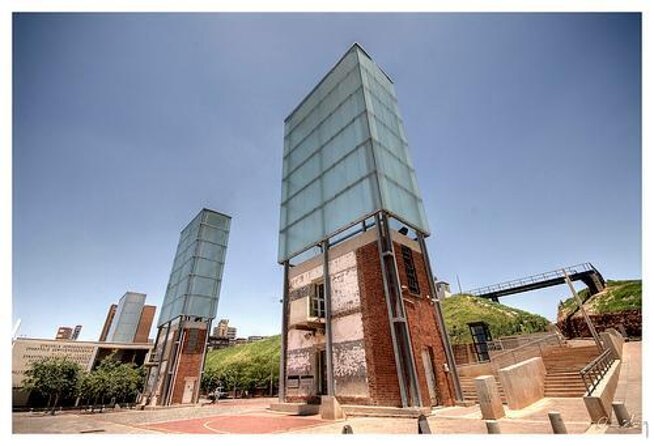
- Constitution Hill anchors the story: The court precinct helps frame South Africa’s move from apartheid rule toward constitutional democracy.
- Newtown brings art and renewal into view: Expect cultural venues, street art, and discussion of how the inner city is being rebuilt.
- Gandhi Square adds another historical layer: This central plaza links Johannesburg to Mahatma Gandhi’s time in South Africa.
- Lunch and water are included: That makes the $77.92 price easier to assess than a tour that leaves meals to you.
- Pickup is offered, but confirm the details: The experience is described as being in Pretoria while the route is in Johannesburg, so check the meeting point and transfer arrangements before paying.
Why this walking tour gives Johannesburg context
Johannesburg is often reduced to two ideas: a dangerous downtown and a wealthy northern suburb. Both are incomplete. This experience tries to explain how the city reached its current shape, including the movement of businesses toward Sandton and the northern suburbs, the effects of apartheid, and the informal economy that grew in the inner city.
That approach matters because the city’s appearance can change from one block to the next. A guide who knows what used to occupy a square or building can turn an ordinary pavement into part of a much larger story. Several guides are praised for answering questions, adding personal knowledge, and making the past connect to what you see now.
You should expect conversation, interpretation, and observation more than a long list of monument facts. The route is designed to help you ask why Johannesburg changed, not simply where to take a photograph.
The safety discussion is also part of the tour’s purpose. A guide cannot remove every urban risk, but a local escort can help you move through unfamiliar areas with better judgment. I would still keep valuables out of sight, stay with the group, and follow the guide’s instructions.
More Walking Tours in Pretoria
- Pretoria: Cullinan Surface Diamond Mine Walking Tour
★ 4.5 · 58 reviews - Soweto walking tour with a taxi ride
★ 4.5 · 42 reviews - Elephant Walk Guided Half Day Tour from Johannesburg
★ 5.0 · 26 reviews
Braamfontein: a former farm turned inner-city district
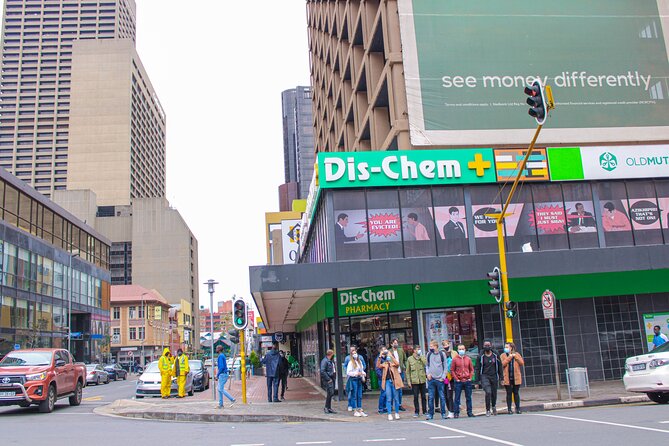
The tour begins in Braamfontein, just north of Johannesburg’s central business district. Its name may sound like a modern city district, but the area dates back to 1886, when it began as a farm before becoming part of Johannesburg’s growing urban core.
Braamfontein later formed part of the city’s business and institutional center. As companies and institutions moved toward Sandton and the northern suburbs, the area lost some of its old role. It did not simply disappear, though. A less formal economy took root, and the district gained a different kind of energy.
This is a good place to begin because it shows that urban decline is rarely a simple story of a place being abandoned. You can look at Braamfontein as a district in transition, shaped by business decisions, migration, changing property patterns, and attempts to restore inner-city life.
The scheduled time here is about one hour. That should give you enough room for explanation without turning the opening stop into a museum visit. Since admission is listed as free, the value comes mainly from the guide’s interpretation and from seeing how the district functions today.
Constitution Hill and the road to constitutional democracy
Constitution Hill is located at 11 Kotze Street in Braamfontein, near the western end of Hillbrow. It is home to South Africa’s Constitutional Court, making it one of the most important political and legal sites on the route.
The precinct helps explain a key contrast in South African history. The country’s present constitutional order is connected to a site associated with the hard realities of the earlier system. That contrast gives the tour a strong foundation before you continue into the surrounding streets.
The supplied route information does not spell out every building or exhibit you will enter, so you should not assume this is a full, ticketed museum tour of the precinct. It is safer to think of Constitution Hill as a major interpretive stop within a broader city walk.
That distinction matters if you are comparing this experience with a dedicated Constitution Hill visit. If you want every prison exhibit and court detail, you may need more time elsewhere. If you want a guide to connect the precinct with Johannesburg’s neighborhoods and modern problems, this format has an advantage.
African art and the city’s creative voice
One stop is described as a museum displaying thousands of African artworks, from historic pieces to contemporary work. The name is not specified in the information provided, so confirm the exact museum before booking if that detail is important to you.
The art stop adds needed breadth. Johannesburg’s story is not only about laws, prisons, mines, and political movements. Art can show how African identities, ideas, and daily life have been represented across different periods. It also gives you a change of pace after the heavier political material.
The amount of time devoted to the museum is unclear. You might receive a short guided visit, or the stop may be folded into the wider walking route. If you are an art specialist, ask whether admission and enough viewing time are included. For most people, the attraction here is the chance to see African art within the city’s wider cultural setting.
More lunch stops in Pretoria:
- Apartheid History of South Africa (Full day Experience with lunch
★ 4.5 · 24 reviews - From Cape Town: Big Five Game Reserve with Lunch
★ 4.6 · 2,409 reviews - Wine Tour to Stellenbosch & Franschhoek with Tastings & Lunch
★ 5.0 · 828 reviews - Soweto: Walking Tour with a Local Guide and Lunch
★ 4.9 · 648 reviews
Nelson Mandela Bridge and the view toward Newtown
The route includes a bridge crossing the railway lines and sidings west of Johannesburg Park Station. It is the fourth of five such bridges in that area and was completed in 2003 at a reported cost of R38 million.
The most likely connection is the Nelson Mandela Bridge, which links Braamfontein with Newtown and serves as a gateway from the north. The route description identifies Newtown as being connected by this bridge, but it does not name the bridge stop directly, so confirm the exact crossing with the operator.
A bridge is more than a photo stop here. It lets you see how rail lines divide parts of the inner city and how transport routes shape access. It also gives the guide a natural point to explain the relationship between Braamfontein, Park Station, and Newtown.
This part may feel less structured than entering a museum. That is normal. The reward comes from seeing the city’s physical layout while you hear why these connections matter.
Newtown: culture, regeneration, and a changing center
Newtown lies in Johannesburg’s inner city between the railway lines to the north, the M2 highway to the south, West Street to the east, and Quinn Street to the west. It is described as a major area of regeneration and reinvention.
The Nelson Mandela Bridge carries around 3,000 cars per hour and helps form a northern gateway into the city. That detail gives you a practical sense of Newtown’s role. It is not an isolated cultural quarter. It is tied to traffic, railways, highways, and the daily movement of people through Johannesburg.
Newtown is a mixed-use district with cultural facilities, including the Market Theatre. The theater played an important role in South African theater during apartheid, making it a useful stop for understanding how culture challenged political restrictions.
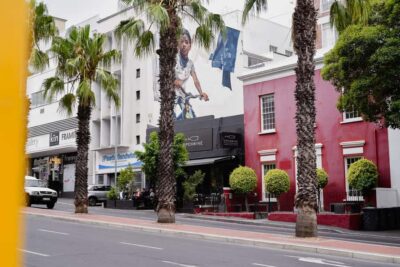
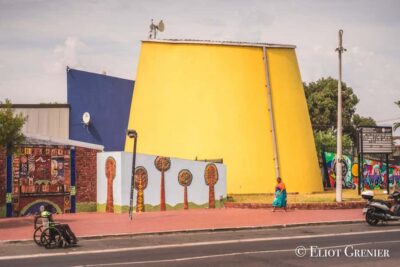
You may also see street art, which several guide experiences place among the memorable parts of the route. The art is not just decoration. It can help you notice how the city’s public spaces are used to express identity, politics, memory, and local pride.
The scheduled time is about one hour, with admission listed as included. Since Newtown covers a sizable area, the guide has to choose carefully between cultural venues, public art, streets, and historical explanation. Ask at the start how much time will be spent walking outside compared with entering attractions.
Newtown is also where the tour’s balance becomes most useful. Regeneration does not mean every problem has vanished. You can see renewal beside hardship, cultural projects beside neglected buildings, and public optimism beside practical urban challenges.
Gandhi Square and the city’s international past
The final named stop is Gandhi Square in Johannesburg’s central business district. The plaza is named for Mahatma Gandhi, the political activist and pacifist who spent part of his life in South Africa.
This stop adds a different thread to the tour. Johannesburg’s past includes more than the national struggle against apartheid. It also reflects the movement of people, political ideas, and communities across borders. A guide can use the square to discuss Gandhi’s South African years and the way his public image has been remembered.
The itinerary allows about one hour here, and admission is included. The square itself is a public urban space rather than a conventional museum, so the quality of the stop depends heavily on the guide’s explanation.
I would pay close attention to how the guide handles Gandhi’s legacy. A good discussion should leave room for complexity rather than treating any historical figure as a simple hero. The wider value of the stop is that it shows Johannesburg as a city shaped by several overlapping histories.
What the guides add to the route
The strongest feature of this experience is the guide. Sean is repeatedly singled out for explaining South African history, different cultures, people, and the role of art in the city. He is also described as patient with questions and reassuring during the walk.
Other named guides include Nkosi, Tigh, Romeo, Frank, Angela, Thai, and B. K. The specific guide is not guaranteed, so I would not book solely on the hope of getting one particular person. Still, the range of guide names suggests that the company has several people who lead the route.
The best guide style for this tour is conversational and local. You want someone who can explain what a street was like in earlier years, why conditions changed, and how current problems connect to past policies. You also want someone who can answer an unexpected question without losing the route’s main thread.
One useful feature is flexibility. The experience has been adapted in at least one case to begin earlier and combine the central business district with the Apartheid Museum and Soweto over roughly six hours. That does not mean the longer combination is part of every booking, but it suggests you can ask about adjustments if your schedule or interests call for them.
Safety, pace, and the walking conditions
This is a city walk, not a coach tour with occasional steps onto the pavement. You need to be ready to walk for several hours, with stops for explanation and lunch. Most people can participate, and service animals are allowed.
Some parts of the route may feel uncomfortable. That does not automatically mean the experience is unsafe, but it does mean you should take the setting seriously. Stay near the guide, avoid displaying expensive items, and do not wander away to take a photograph.
The included air-conditioned vehicle and offered pickup are useful, especially if you are staying outside central Johannesburg. The booking information gives Pretoria as the location even though every listed stop is in Johannesburg. That is a meaningful inconsistency, not a minor spelling issue. Before booking, confirm whether pickup from Pretoria is available, where the tour begins, and whether transport returns you to the original pickup point.
The group can contain up to 30 people. That is large enough for a lively outing but not ideal if you want every question answered at length. If you are traveling alone, ask whether the tour operates with a small minimum group or can proceed privately. One guide did continue with a single participant in a reported case, but that should not be treated as a guarantee.
Lunch, timing, and the $77.92 price
At $77.92 per person, the price is above what you would pay for a basic free-style walking tour, but this is a different product. You are paying for a guide, an air-conditioned vehicle, bottled water, lunch, and a route that handles difficult history and present-day urban issues.
The three-to-five-hour duration gives the price reasonable value if you want a structured first look at central Johannesburg. Lunch helps, particularly if you are fitting the walk into a busy sightseeing day. Alcoholic drinks are not included, so budget separately if you want them.
The timing can vary within a wide range. Three hours may feel brisk, while five hours allows more explanation, slower walking, or additional stops. Ask what your exact start and finish times will be, especially if you have a flight, another tour, or a Pretoria transfer to manage.
I would choose this tour over a cheaper panoramic drive if your main goal is understanding the city. I would choose a dedicated museum visit instead if you prefer carefully labeled exhibits and more time indoors.
Who should book this Johannesburg experience
You should consider booking if you want:
- A first introduction to Johannesburg’s central districts
- History connected to real streets and public spaces
- Honest discussion of safety and urban change
- A guide-led walk with lunch included
- Cultural stops that include art, theater, street art, and public plazas
- A flexible experience that may be adapted to your interests
This tour suits curious adults, solo visitors who prefer local guidance, and families with older children who can handle serious history and a few uncomfortable sights. One family found the guides engaging enough to keep children involved for more than two hours, though younger children may tire during a three-to-five-hour city walk.
You may want something else if you want luxury, predictable sightseeing, or a quiet route through only restored districts. This is an honest look at a complicated city, and that means the experience can feel raw.
The tour carries a 4.7 rating, with 94 percent recommending it, based on 17 ratings. That is a strong result, though the sample is modest. The clearest pattern is the praise for guide quality, historical explanation, friendliness, and the feeling of security created while walking.
Should you book it?
Book this tour if you want Johannesburg explained from the pavement up. Constitution Hill, Newtown, Gandhi Square, African art, rail bridges, and street art give you more than a quick list of attractions, while the guide helps connect them to apartheid, migration, business, culture, and the city’s future.
I would confirm the Pretoria versus Johannesburg pickup details before booking, and I would ask which guide, museums, admissions, and exact lunch arrangement apply to your date. If those details work for your schedule, the price is fair for a guided city walk with transport support, food, and serious historical context.
FAQ
Where does the tour take place?
The route takes place in Johannesburg and includes Braamfontein, Constitution Hill, Newtown, and Gandhi Square. The booking information also lists Pretoria as the location, so confirm the exact pickup and meeting arrangements before booking.
How long does the tour last?
The experience lasts approximately three to five hours. Exact timing may vary, so check the start and finish times for your selected date.
Is pickup available?
Pickup is offered, and an air-conditioned vehicle is included. Because the location information refers to both Pretoria and Johannesburg, confirm whether pickup from your accommodation is available and where the walking portion begins.
Is lunch included?
Yes. Lunch and bottled water are included in the price. Alcoholic beverages are not included.
How many people can join the tour?
The maximum group size is 30 people. The exact group size for your date is not specified.
Can I cancel for a full refund?
Yes, if you cancel at least 24 hours before the experience start time. Cancellations made less than 24 hours before the start time are not refunded, and changes within that period are not accepted. If poor weather causes the tour to be canceled, you will be offered another date or a full refund.
Just listed around Pretoria
- Kruger National Park 2 Days 1 Night Magical Safari from Johannesburg Private★ 5.0 · 5 reviews
- Pretoria Capital City Tour from Pretoria, every TUESDAY★ 4.5 · 5 reviews
- Constitutional Hill,Johannesburg City and Apartheid Museum with Soweto Day Tour★ 5.0 · 5 reviews
- Apartheid museum, Soweto and Joburg highlights tour★ 5.0 · 6 reviews
- From Pretoria: E-Bike in the wild with game near Jo’burg★ 5.0 · 6 reviews
- Pretoria: Half-Day City Tour with Hotel Pickup★ 4.2 · 6 reviews
- Traditional Tribal Village Tour★ 5.0 · 6 reviews
- Full-Day Cradle of Humankind Guided Tour from Johannesburg or Pretoria★ 4.5 · 6 reviews
Walking Tours, compared.


Browse the lists this tour appears in