

Reviewed · WALKING TOURS
Innercity Walking Tour
Johannesburg makes far more sense at street level, and this four-hour walk takes you well beyond the usual bus-window view. You move from the art-led renewal of Maboneng to a traditional market, a giant second-hand bookshop, and the old offices of Mandela and Tambo.
I like the mix of local culture and major history, and I like that the route includes places most quick city tours skip. The main caution is pace: with several hours on foot and a moderate fitness requirement, this is not a gentle sightseeing ride.
I also appreciate the flexible transport plan. The experience is built around walking, though a minibus or other air-conditioned vehicle may be used between sections. Guides such as Thepso and Brite are praised for making the city easy to understand, but bring water and do not expect lunch or refreshments to be included.
Key points at a glance
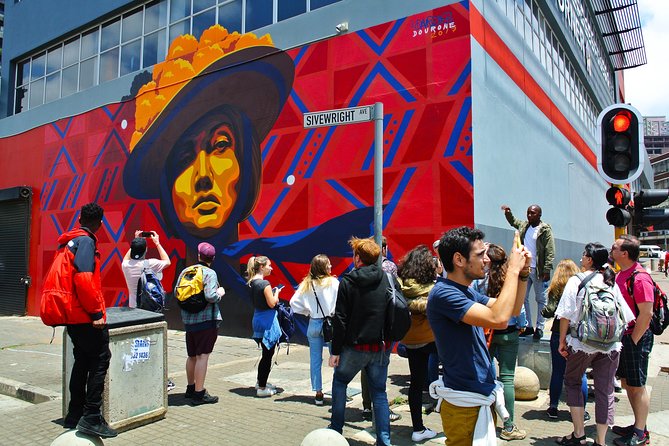
- Maboneng in 45 minutes: See how an area once viewed as unsafe became a center for artists, designers, and small businesses.
- Kwa Mai Mai Market: Browse more than 176 stalls selling traditional medicine, clothing, beadwork, walking sticks, and crafts.
- Carlton Centre views: Spend an hour learning about Johannesburg from 223 meters above the city.
- Collectors Treasury: Explore an eight-story second-hand bookshop filled with books, maps, records, postcards, and porcelain.
- Mandela and Tambo’s legal office: Visit Chancellor House and the nearby Shadow Boxing sculpture.
- Small-group format: The group can include up to 20 people, with a 10 a.m. start and return to the meeting point.
Why this walk gives you a clearer Johannesburg
Johannesburg is a city of sharp changes. A polished art district can sit close to older commercial streets. A market selling traditional remedies may be a short walk from a modern skyscraper. This tour works because it does not try to smooth out those contrasts.
You spend time on foot, so you can see shopfronts, street art, old buildings, public squares, and everyday city movement at close range. The guide also explains how to navigate public transport, which gives the outing a practical edge. You are not only collecting sights. You are learning how the central city fits together.
The route also links several periods of Johannesburg’s past. Gold brought the city to life in 1886. The center later suffered years of decline in the late 1980s and 1990s. Today, parts of the inner city are being reshaped through art, small business, tourism, and community activity.
That story gives the walk its purpose. You see places that are attractive, complicated, historic, and still changing.
More Walking Tours in Johannesburg
- Soweto: Walking Tour with a Local Guide and Lunch
★ 4.9 · 648 reviews - Soweto Walking Tour with Lunch
★ 5.0 · 288 reviews - Johannesburg: Local Food Tasting Guided Walking Tour
★ 4.7 · 192 reviews
Maboneng: art and renewal on Fox Street
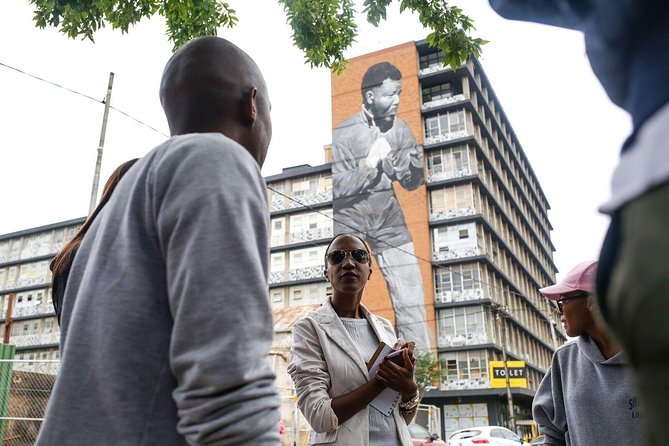
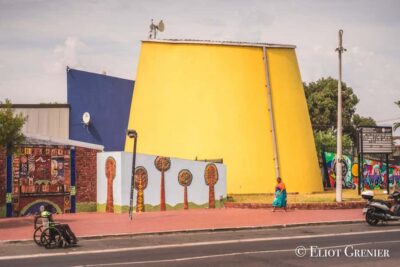
The tour begins at 302 Fox Street in Jeppestown and heads into the Maboneng Precinct. The name means Place of Light, which fits a district known for art, design, food, and creative businesses.
Maboneng was once widely viewed as a no-go area because of urban decay. A redevelopment plan put art near the center of the neighborhood’s renewal, and the result is one of Johannesburg’s best-known inner-city areas for street art and creative work.
You have about 45 minutes here, with admission included. That is enough time to get a sense of the district without letting the first stop swallow the whole tour.
I like Maboneng as an opening stop because it gives you a quick lesson in how cities change. The area is not simply an art backdrop. It helps explain the wider effort to bring people, business, and public life back into parts of the city center.
The tradeoff is that Maboneng can feel more polished and visitor-oriented than some of the later stops. If you want only old Johannesburg, it may seem too new. If you want to understand the city’s present-day changes, it is essential.
Kwa Mai Mai Market: practical culture and handmade goods
Next comes Kwa Mai Mai Traditional Market, one of Johannesburg’s oldest markets. The market began in an old horse stable and now contains more than 176 stalls.
You will find traditional medicines, African clothing, beaded items, artifacts, walking sticks, and other craftwork. This is a better stop for useful cultural context than for a quick photo. The objects on sale connect to local traditions and offer a different kind of souvenir from the usual airport merchandise.
The planned visit lasts about 30 minutes. That is enough for a first look, though not enough for a long, unhurried shopping session at every stall.
I would keep your expectations practical. This is an operating market, not a museum arranged for visitors. Displays may feel crowded, and the experience is more about seeing the range of goods and listening to the guide than making a carefully planned purchase.
The stop also adds balance to Maboneng. One shows a newer creative economy. Kwa Mai Mai gives you a look at older trading traditions and local commerce.
Collectors Treasury: eight floors of paper history
Collectors Treasury is a fine surprise on this route. It is described as the largest second-hand bookstore in the Southern Hemisphere, with books packed through an eight-story building.
The collection includes books, LPs, maps, porcelain, and postcards. You may find the building more interesting than any single item. Stacks of printed material create a feeling that is hard to get in a modern bookshop, where everything is neatly spaced and brightly labeled.
The visit lasts about 15 minutes, so treat it as a quick browse rather than a serious book hunt. If you collect maps, old records, postcards, or unusual books, you may wish for more time.
Still, this short stop works well in the middle of a walking tour. It offers a quiet change of pace after the market and gives the guide another way to explain Johannesburg’s commercial and cultural life.
A different side of Johannesburg altogether:
- From Johannesburg: Pilanesberg Nature Reserve Game Safari
★ 4.8 · 1,327 reviews - Johannesburg: Hop-On Hop-Off Bus with Optional Soweto Tour
★ 4.6 · 985 reviews - Soweto /Johannesburg and Apartheid Museum Guided Full Day Tour
★ 5.0 · 932 reviews - Johannesburg Hop-On Hop-Off City Tour with Soweto Option
★ 4.5 · 768 reviews
Carlton Centre: Johannesburg from 223 meters up
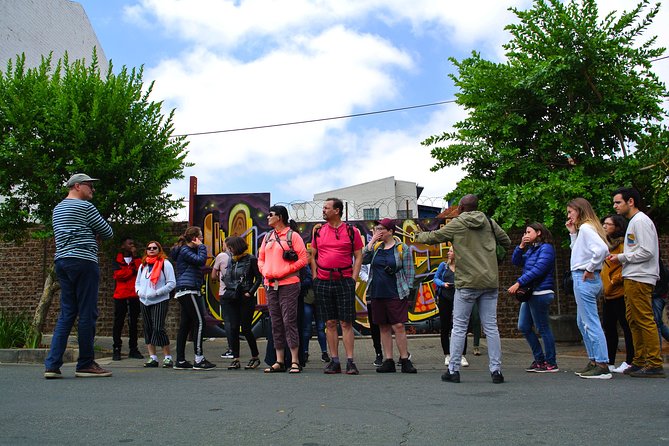
The Carlton Centre is the biggest single time commitment on the route, with about an hour planned here. Built between 1969 and 1976 by the American architecture firm Skidmore, Owings and Merrill, it rises 223 meters above Johannesburg.
The panoramic view is the main draw. From above, the city’s streets and districts become easier to read. You can better understand the relationship between the older mining center, newer development, and areas that have gone through years of decline.
The guide uses the view to explain Johannesburg’s story from the 1886 gold rush through the difficult decades of the late twentieth century and into the current effort to revive the center. That context matters. A skyline view by itself can be pleasant but vague. Here, it is meant to help you connect the city’s physical form with its past.
An hour is generous compared with the short visits elsewhere. That gives you time to take in the panorama and listen without rushing.
The Carlton Centre also offers a useful pause from street walking. You are still learning about the city, but your feet get a break. If high viewpoints make you uneasy, this stop may be less appealing, but it is one of the tour’s strongest orientation points.
Gandhi Square and the Main Street mining district
Gandhi Square takes about 20 minutes. It is named for Mahatma Gandhi, who spent 21 years in South Africa and had his law firm in downtown Johannesburg.
This stop connects the city to Gandhi’s time as a lawyer and human rights activist. It also helps you understand how central Johannesburg’s public spaces have been named, used, and remembered.
The visit is brief, so do not expect a long museum-style presentation. The value comes from the guide’s explanation and from seeing the square as part of the surrounding downtown route.
From here, the walk continues through the Main Street mining district toward Chancellor House. The change in scenery is part of the point. You move through an area shaped by mining wealth and legal, political, and business activity rather than simply jumping between isolated attractions.
Chancellor House and the Shadow Boxing sculpture
Chancellor House is one of the most important stops for understanding South Africa’s political past. In the 1950s, its modest three-story building housed Mandela and Tambo Attorneys, the country’s first black-owned law firm.
The planned stop lasts about 30 minutes. Opposite the former office is the Shadow Boxing sculpture by Marcos Cianfanelli, based on a famous photograph by Bob Gosani showing a young Mandela boxing.
The pairing is effective. Chancellor House connects you to the working lives of Mandela and Oliver Tambo as lawyers. The sculpture presents Mandela in a more personal and physical way, before the familiar images of his later political life became so dominant.
This is not a large memorial complex with hours of exhibits. You are seeing a building, a sculpture, and the surrounding streets while the guide supplies the meaning. That makes the explanation especially important.
For me, this is the emotional finish of the route. Maboneng shows a city trying to remake itself. Chancellor House reminds you that Johannesburg was also a place where legal and political challenges to apartheid were organized.
Walking, transport, and physical demands
The tour is sold as an inner-city hiking experience, and you should plan for substantial walking. The stated fitness level is moderate. Comfortable shoes are more important than stylish ones, and you should carry water because lunch and refreshments are not included.
The route also includes guidance on using public transportation. One account of the experience describes a combination of walking and a minibus, with a preference for spending more of the day on foot. That detail is useful because the title may lead you to expect four continuous hours of walking.
An air-conditioned vehicle is included, along with fees and taxes. The vehicle can make the route more manageable, especially between districts, but the heart of the experience is still street-level exploration.
The group may include up to 20 people. That is small enough for a guide to provide commentary without creating the feel of a large coach excursion, though it is not a private tour.
Guide quality and the value of local explanation
The guide can make or break a city walk, and this route depends heavily on clear commentary. Thepso is praised for being accommodating and for knowing the city well. Brite is also singled out for a friendly, cheerful approach and for taking people to unusual places they might not otherwise find.
The important point is not simply that the guides talk a lot. They help connect separate stops into one story. Maboneng, Kwa Mai Mai, Carlton Centre, Gandhi Square, and Chancellor House could feel unrelated if you saw them alone. With context, they become chapters in the history of one city.
A guide also helps with the practical side of walking through the inner city. You learn how public transportation fits into the route and how different parts of central Johannesburg relate to one another.
The quality of the day may vary somewhat with the guide assigned. That is normal for a walking tour, but the strong comments about Thepso and Brite suggest that the provider has guides who can make the experience personal rather than mechanical.
Is $50.04 a fair price?
At $50.04 per person, the tour is not the cheapest way to see Johannesburg. It is also not simply a four-hour stroll. The price includes a guide, an air-conditioned vehicle, admission fees, and taxes, so you do not need to keep adding small entrance costs as the day goes on.
The strongest value comes from the range of stops. In four hours, you visit a creative precinct, a traditional market, a major bookshop, a skyscraper viewpoint, a public square, and a landmark tied to Mandela and Tambo.
I think the price makes sense if you want interpretation and a planned route. You could visit some of these places independently, but connecting them by public transport and understanding their place in the city’s story would take more preparation.
It is less attractive if you mainly want free time for shopping, long photography stops, or lunch. Food is not included, and the schedule moves through several locations rather than lingering at one.
The tour is often booked about 37 days ahead, so planning early is sensible if your Johannesburg dates are fixed. Confirmation arrives at booking, and free cancellation is available up to 24 hours before the start time.
Who should book this Johannesburg walk?
I would choose this experience if you are visiting Johannesburg for the first time and want a grounded introduction to the inner city. It suits people who prefer streets, markets, old buildings, and conversation over a sealed coach window.
It is also a good fit if you want to understand the city’s changes rather than see only its most polished areas. The route includes places connected to renewal, trade, books, mining, law, and political history.
You may want another option if you have difficulty walking for several hours, dislike uneven or crowded urban settings, or want a relaxed meal built into the schedule. The moderate fitness requirement is worth taking seriously.
Families with older children, solo visitors, and curious repeat visitors can all get something from it. Repeat visitors may especially value the less standard stops, while first-time visitors will appreciate the route planning and city orientation.
Final verdict: a strong choice for an honest city introduction
You should book this tour if you want Johannesburg explained from the ground up, one neighborhood and landmark at a time. The combination of Maboneng, Kwa Mai Mai Market, Collectors Treasury, Carlton Centre, Gandhi Square, and Chancellor House gives you a much fuller picture than a quick drive through downtown.
I especially like the balance between present-day renewal and difficult history. The main drawback is the physical pace, plus the lack of included food or long free periods.
For a four-hour introduction at $50.04, the value is good when you want a local guide, included admissions, transport support, and a route that reaches beyond standard city sights.
FAQ
Where does the Johannesburg Innercity Walking Tour begin?
The tour begins at 302 Fox Street, Jeppestown, Johannesburg, 2043, South Africa.
What time does the tour start?
The tour starts at 10:00 a.m.
Where does the tour end?
The activity ends back at the meeting point.
How long does the tour last?
The tour lasts approximately four hours.
What places are visited?
The route includes Maboneng Precinct, Kwa Mai Mai Traditional Market, Collectors Treasury, Carlton Centre, Gandhi Square Precinct, and Chancellor House.
Is transportation included?
An air-conditioned vehicle is included. The tour also teaches you about navigating Johannesburg’s public transportation, and the experience may combine walking with minibus travel.
Is lunch included?
No. Lunch and refreshments are not included.
How many people can join the tour?
The group can include a maximum of 20 people.
What fitness level is needed?
A moderate level of physical fitness is recommended because the experience involves walking through Johannesburg’s inner city.
Can I cancel for a full refund?
Yes. You can cancel up to 24 hours before the experience start time for a full refund. Changes or cancellations made less than 24 hours before the start time are not accepted for a refund.
Just listed around Johannesburg
- Constitutional Hill and Soweto 5 hours tour.★ 5.0 · 5 reviews
- 5 Day Kruger Glamping Safari and Panorama Tour★ 5.0 · 5 reviews
- Cradle of Humankind and Maropeng Day Tour from Johannesburg★ 4.0 · 5 reviews
- Johannesburg: Hot Air Balloon Flight★ 5.0 · 5 reviews
- Half Day Soweto and Apartheid Museum Guided Tour★ 5.0 · 5 reviews
- Lion park★ 4.5 · 5 reviews
- Pretoria Historical Tour★ 4.0 · 5 reviews
- 5 Day Kruger National Park and Panorama Route Safari★ 4.5 · 5 reviews
Walking Tours, compared.





Browse the lists this tour appears in