

Reviewed · CITY TOURS
Johannesburg City Centre Walking Tour
Johannesburg makes the most sense at street level, where old mining-era buildings, public squares, working neighborhoods, and sharp reminders of apartheid history sit close together. This guided walk gives you a safer, more grounded way to see central Jozi, with stops at Chancellor House, the Workers Museum, Main Street, and Gandhi Square.
I like the small group limit of 10, since it leaves room for questions and makes it easier for your guide to keep an eye on the group. I also like the ending: a South African braai lunch in Maboneng, with plant-based choices, turns a history lesson into a social afternoon.
The main consideration is that Johannesburg’s city center can feel rough and uneven in places. You should stay close to your guide, expect plenty of walking, and understand that the route may use a taxi or Uber between areas rather than remain on foot from start to finish.
Why this Johannesburg walk works

- Main Street shows the old mining city: See heritage buildings and feel the pace of central Johannesburg around the city’s original commercial core.
- Chancellor House connects directly to Mandela and Tambo: Visit the office where Nelson Mandela and Oliver Tambo founded South Africa’s first Black-owned law firm.
- The Workers Museum adds human scale: Learn about the migrant labor system and the former workers’ compound in a setting that is more personal than a standard city viewpoint.
- The Top of Africa offers a high city view: Look across Johannesburg from one of the city’s major skyscrapers.
- Maboneng supplies the social finish: End with a braai, local atmosphere, arts, music, and time to eat.
- A local guide changes the experience: Guides including Mathapelo, Tebogo, Mulalo, Kutlwano, and Sibongile have been praised for honest explanations, safety awareness, and practical help.
Starting at Gandhi Square and Main Street
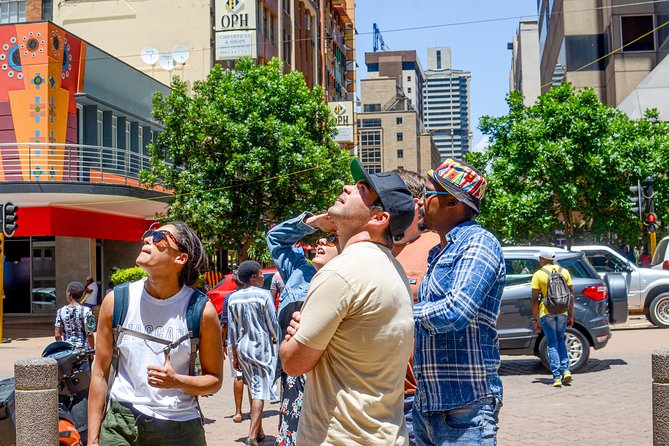
The tour begins outside Nando’s at Gandhi Square in Marshalltown. That is a useful starting point because Gandhi Square is easy to identify, close to public transport, and already places you in the middle of Johannesburg’s central business district.
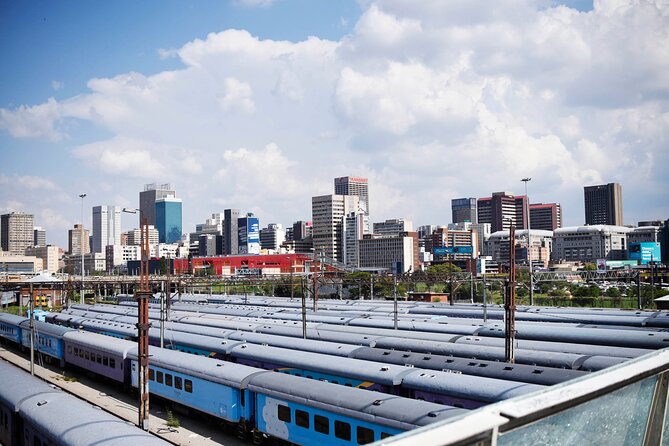
From here, you walk through the core of the city rather than viewing it from a bus window. The first substantial stop is Main Street, where your guide points out older architecture and explains how Johannesburg grew from a mining settlement into South Africa’s financial center.
Give yourself time to look upward. Central Johannesburg has a mix of grand older facades, later commercial buildings, street signs, public art, and signs of wear. The appeal is not polished perfection. It is the contrast between the city’s former wealth, its present-day pressures, and the daily life moving around both.
A guide is especially useful here because the meaning of a building is not always obvious. You might walk past a plain entrance without realizing its connection to labor, law, business, or political change. Guides such as Tebogo and Mathapelo have been praised for adding music, personal perspective, and plain explanations instead of reciting dates.
More Walking Tours in Johannesburg
- Soweto: Walking Tour with a Local Guide and Lunch
★ 4.9 · 648 reviews - Soweto Walking Tour with Lunch
★ 5.0 · 288 reviews - Johannesburg: Local Food Tasting Guided Walking Tour
★ 4.7 · 192 reviews
The Workers Museum and the cost of Johannesburg’s growth
The Workers Museum is one of the most worthwhile stops because it shifts attention away from famous leaders and grand buildings. The site was formerly a compound for workers, and it helps explain the migrant labor system that supported Johannesburg’s mines and industries.
Plan on about 20 minutes here. That is enough time for a focused introduction, though not enough for a long museum visit if you want to study every display at length. The stop works best as part of the walking route, giving you a clear sense that Johannesburg’s growth depended on people who often lived far from their families and had limited freedom.
This is also where the tour gains emotional weight. You are not only looking at city architecture. You are learning how work, movement, housing, and racial policy shaped everyday life. One French-language account described the museum as especially useful for understanding both Johannesburg and South Africa. I agree with that practical assessment: this is the stop that gives the rest of the walk a human center.
Chancellor House and the legal fight for equality
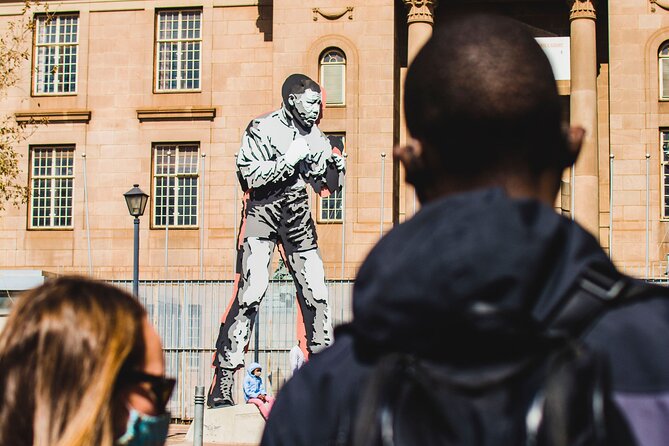
Chancellor House is a compact but powerful stop. It was the office of Nelson Mandela and Oliver Tambo, who founded South Africa’s first Black-owned law firm there.
You spend about 15 minutes at the site, so expect a concise explanation rather than a full museum visit. The value comes from the location itself. Mandela is often presented through monuments and large national narratives. Here, you are connected to his work as a lawyer, where clients came with real legal problems in a system built to deny them equal rights.
Your guide can also link Chancellor House to the surrounding streets and political history. This is one reason a local guide matters. You can ask how the city remembers Mandela, how ordinary people relate to his legacy, and what has changed since his legal career began.
Mathapelo has been praised for offering direct, honest accounts of South African history, while Kutlwano has been appreciated for sharing personal views and suggestions for what else to see. Those qualities suit Chancellor House well. You want context, not only a photo stop.
Mary Fitzgerald Square and the public life of Jozi
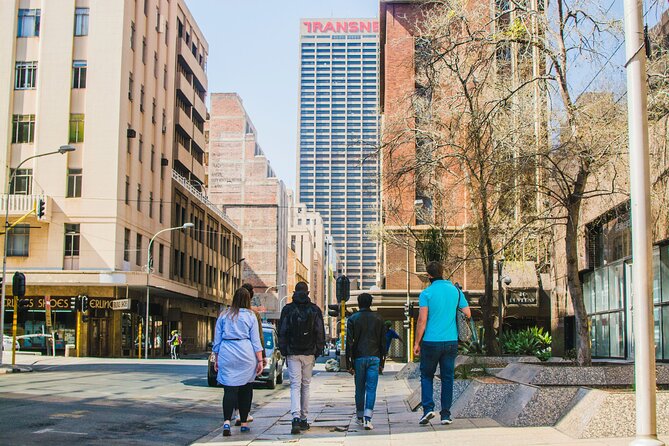
Mary Fitzgerald Square is another brief stop, listed at about 10 minutes. It is often used for meetings and public gatherings, so your guide can explain how open urban spaces function in Johannesburg’s civic life.
The square also gives you a pause between museum and street stops. You can watch the city rather than rush through it. Depending on the day, you might find a quiet stretch or a livelier public setting, but the important point is its role as a place where people gather.
The tour’s walking pace seems intentionally relaxed. Clement, one of the guides, has been praised for making the outing feel like a stroll with a friend, while still explaining the cultural and political background. That balance matters. A rigid lecture can flatten a city. A casual walk without context can leave you with little more than photographs.
A different side of Johannesburg altogether:
- From Johannesburg: Pilanesberg Nature Reserve Game Safari
★ 4.8 · 1,327 reviews - Johannesburg: Hop-On Hop-Off Bus with Optional Soweto Tour
★ 4.6 · 985 reviews - Soweto /Johannesburg and Apartheid Museum Guided Full Day Tour
★ 5.0 · 932 reviews - Johannesburg Hop-On Hop-Off City Tour with Soweto Option
★ 4.5 · 768 reviews
The Top of Africa and the city from above
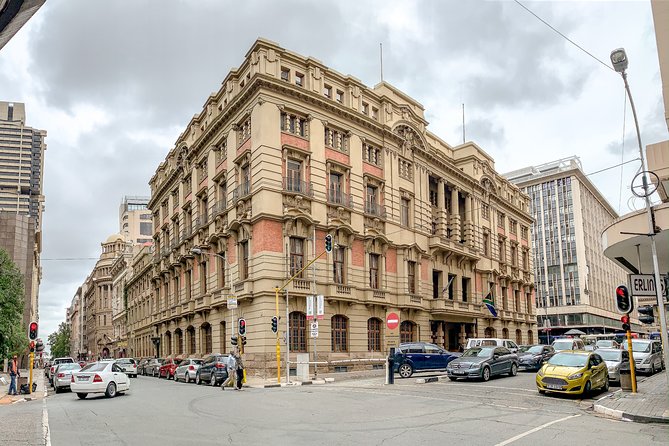
The Top of Africa is included as a highlight and adds a useful change of scale. After walking among buildings and people, you get a broad view over Johannesburg from a skyscraper.
This is the place for your clearest city photographs. It also helps you understand Johannesburg’s spread, density, and changing urban form in a way that street level cannot. Look back at the areas you have crossed and consider how close the city’s different eras sit to one another.
The available schedule does not give a separate time for the Top of Africa, and the short itinerary lists only some of the stops in detail. For that reason, treat the exact order as flexible. Ask at the start how the viewpoint fits into the day, especially if you have a strict onward booking.
Walking through the city center with local guidance
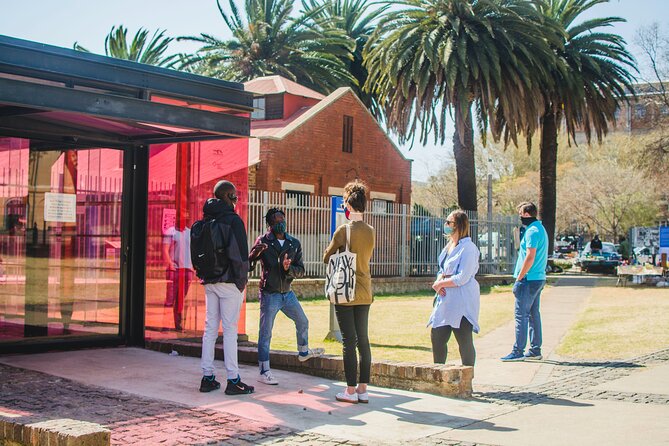
The heart of the experience is not any single building. It is the act of walking through central Johannesburg with someone who understands where to go, how long to pause, and when to move on.
Safety is a major reason to book. Johannesburg’s reputation can make independent exploration feel intimidating, and several guides have been praised for keeping groups together and steering them away from areas that felt less secure. In one case, the guide arranged a taxi through a riskier stretch. Sibongile also helped a participant order an Uber and checked that the person reached the hotel safely.
That does not mean the city center becomes risk-free. Keep your phone and camera secure, stay with the group, and follow the guide’s instructions. Avoid wandering off for a solo photograph or assuming that a busy street is automatically safe. The tour gives you local judgment, not a protective bubble.
The group limit of 10 is a real advantage. A smaller group can move more easily, and you can ask about apartheid, music, architecture, daily life, or transport without shouting across a crowd. The individual guide will shape the tone, but the strongest descriptions point to guides who are friendly, flexible, and willing to answer questions.
The ride to Maboneng and the braai finish
The tour ends with lunch in the Maboneng Precinct, an arts-focused part of Johannesburg known for creative spaces, crafts, music, and public energy. The route may include a taxi from the central city to Maboneng, so do not assume every part of the experience is walking.
That transfer is practical rather than glamorous, but it also gives you another look at the city. One account described the taxi ride as part of the fun. More importantly, your guide can judge when a car makes more sense than continuing on foot.
Lunch is a traditional South African braai, or barbecue, and is one of the tour’s best features. It gives you a chance to try local food in a social setting instead of eating alone between sightseeing stops. Chakalaka, a spicy vegetable relish, has received special praise, and plant-based options are available.
The meal is also a useful test of the tour’s value. A three-hour walk can leave you tired and hungry, while a shared meal lets the day finish at an easier pace. The exact restaurant and menu are not specified, so you should not book this expecting a formal tasting menu. Think of it as a local lunch with a traditional focus.
What $45.19 gets you
At $45.19 per person, this is not the cheapest way to see Johannesburg’s center. You are paying for a local guide, a planned route, safety awareness, city interpretation, water, and the braai lunch. The small group size makes the price easier to justify, particularly if you are new to Johannesburg.
Admission is listed as free at the named walking stops, so the cost is not mainly about entry tickets. It is about access to places you might hesitate to visit alone and about having someone explain what you are seeing.
Additional items and costs are not included. That wording matters. If the route uses a taxi or Uber, confirm whether your fare is separate. Also allow for personal drinks, souvenirs, or other purchases in Maboneng.
The tour is commonly booked about 21 days ahead. That suggests you should reserve early if your Johannesburg dates are fixed, especially since the group is capped at 10. Free cancellation is available up to 24 hours before the start time, which gives you some breathing room when plans change.
Who should book this walk
I would choose this tour for a first visit to Johannesburg, especially if you want to understand the city rather than only visit its major museums and viewpoints. It suits solo visitors, couples, families with older children, and anyone who wants a local introduction before exploring independently.
It is also a strong choice if you are curious about South African politics, labor history, architecture, and ordinary city life. You will hear different layers of the story at the Workers Museum, Chancellor House, Mary Fitzgerald Square, and Main Street.
The tour may be less suitable if you dislike walking, want a highly polished sightseeing route, or need exact timing at every stop. It is a city-center walk, not a luxury vehicle tour. Conditions can feel gritty, and the route may change to account for safety or transport.
You should also be comfortable with a flexible guide-led day. The best moments may be a question, a quick explanation, a local interaction, or a street scene between formal stops. If you want only major attractions with no unscheduled pauses, this may feel loose.
Is the Johannesburg City Centre Walking Tour worth booking?
Yes, I would book it if safety concerns are keeping you away from central Johannesburg. The guide gives you a practical way to see the city’s difficult and fascinating sides, while the small group keeps the experience personal.
The strongest reasons are the Workers Museum, Chancellor House, the city view, and the braai in Maboneng. Guides such as Mathapelo, Tebogo, Mulalo, Kutlwano, and Sibongile have been praised for making the walk feel relaxed while still offering clear history and useful local judgment.
Book it early, wear comfortable shoes, keep valuables discreet, and ask about any taxi cost at the beginning. If you want an honest first look at Jozi, rather than a sanitized postcard version, this $45.19 experience offers good value.
FAQ
How long does the Johannesburg City Centre Walking Tour last?
The tour lasts approximately three hours.
Where does the tour start?
It starts outside Nando’s Gandhi Square, Shop 180, corner of Fox and Gandhi Square, Metropolitan Building, Rissik Street, Marshalltown, Johannesburg.
Where does the tour end?
The stated end point is Constitution Hill Human Rights Precinct, 11 Kotze Street, Braamfontein, Johannesburg, with lunch at the end of the tour.
Is lunch included?
The experience ends with a South African braai lunch in the Maboneng Precinct, and plant-based options are available. Additional items and costs are not included.
Is the Top of Africa included?
The Top of Africa is listed as a tour highlight. The supplied schedule does not give a separate duration for this stop, so ask your guide about the exact timing on the day.
How many people can join the tour?
The maximum group size is 10 people.
Can I cancel for a full refund?
Yes. You can cancel up to 24 hours before the experience start time for a full refund. Changes or cancellations made less than 24 hours in advance are not accepted for a refund.
Just listed around Johannesburg
- Constitutional Hill and Soweto 5 hours tour.★ 5.0 · 5 reviews
- 5 Day Kruger Glamping Safari and Panorama Tour★ 5.0 · 5 reviews
- Cradle of Humankind and Maropeng Day Tour from Johannesburg★ 4.0 · 5 reviews
- Johannesburg: Hot Air Balloon Flight★ 5.0 · 5 reviews
- Half Day Soweto and Apartheid Museum Guided Tour★ 5.0 · 5 reviews
- Lion park★ 4.5 · 5 reviews
- 5 Day Kruger National Park and Panorama Route Safari★ 4.5 · 5 reviews
- Pretoria Historical Tour★ 4.0 · 5 reviews
City Tours, compared.

Cape Town Hop-On Hop-Off City Tour with Optional Cruise
Read our review →

Johannesburg Hop-On Hop-Off City Tour with Soweto Option
Read our review →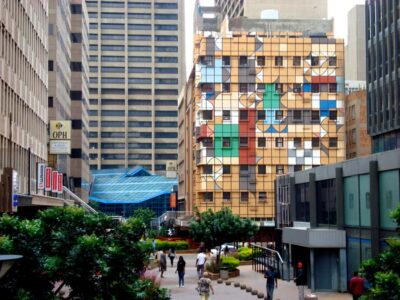
Jo’berg in 1 Day: Soweto, Apartheid Museum & City Tour
Read our review →
Cape Town City Pass: Save Over 50% on 80+ Top Attractions
Read our review →
Hop-On Hop-Off Bus, City Tour and Apartheid Museum
Read our review →

From Sun City: Pilanesberg National Park 3-Hour Game Drive
Read our review →Browse the lists this tour appears in