
Reviewed · PENGUIN COLONY TOURS
Whale, Dolphin & Penguin Island Cruise
Algoa Bay gives you a rare chance to see humpback whales, dolphins, and African penguins in one half-day outing. This slow-paced cruise uses a small twin-engine catamaran, so you spend less time rushing from one sighting to another and more time watching animal behavior and hearing the crew explain what you are seeing.
I like the small maximum group of 20, which gives you room to ask questions and find a good place for photos. I also like the conservation focus, including a tree-planting campaign designed to balance the cruise’s carbon footprint. The main drawback is simple: wildlife is wild. You may see a spectacular mix of animals, but no sighting is guaranteed, and the bay can be choppy or rainy.
Key points at a glance
- Whales from June to early December: Humpback whales pass through Algoa Bay, while southern right whales are usually seen close to shore from July through September.
- Dolphins can approach the boat: Indo-Pacific bottlenose dolphins are seen year-round and may ride the bow waves. Common dolphins can appear in huge groups farther offshore.
- Penguins are viewed from the sea: St. Croix Island is home to an important African penguin colony, but numbers have fallen sharply in recent years.
- A small, once-daily cruise: The four-hour outing begins at 8am and carries no more than 20 people.
- A crew with conservation at its core: The guides and skippers explain animal behavior, local threats, and the wider Algoa Bay ecosystem.
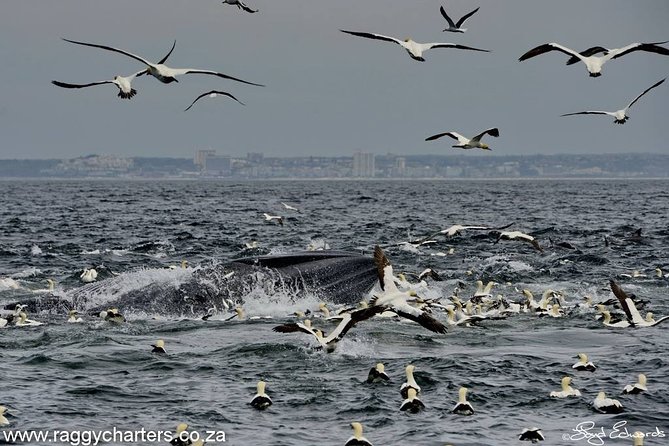
- Good wildlife variety: Seals, sharks, cormorants, Cape gannets, pelagic birds, and several whale species may also appear.
Leaving Port Elizabeth at 8am
You meet the crew at Nelson Mandela Bay Yacht Club, at Dom Pedro Jetty in Port Elizabeth Harbour, now officially called Gqeberha. The boat returns to this same point after roughly four hours, making this an easy morning activity to fit around other plans.
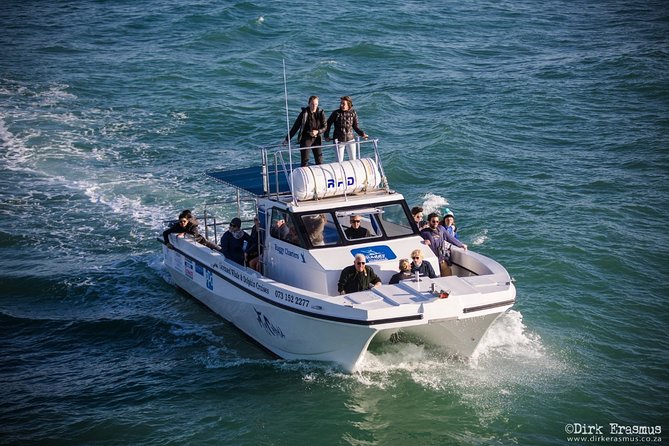
The cruise begins with a short safety briefing before the twin-engine catamaran heads into Algoa Bay. A catamaran gives you a stable platform compared with a narrow boat, though you should still expect movement on the water. One report describes the crew handling choppy conditions well, but the sea can affect how comfortable you feel and how easy it is to take photographs.
The small group matters here. With a maximum of 20 people, you are not packed shoulder to shoulder on a large sightseeing vessel. You have a better chance of hearing the commentary, asking about a particular animal, and shifting position when the skipper lines up a sighting.
The cruise only runs once a day, so the 8am start is fixed rather than flexible. I would plan to arrive with time to spare, especially if you need to find the yacht club or are relying on nearby public transport.
More Boat Tours in Port Elizabeth
- Port Elizabeth: River Cruise on the Sundays River
★ 4.6 · 112 reviews - Port Elizabeth: Sandboarding with Short Boat Trip
★ 4.7 · 62 reviews - Shore Excursion Cruise Ships Port Elizabeth, Addo Elephant Park
★ 5.0 · 24 reviews
Whales in Algoa Bay from June to December
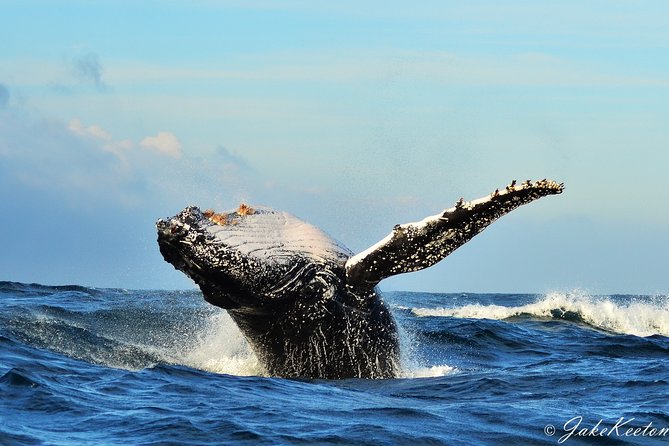
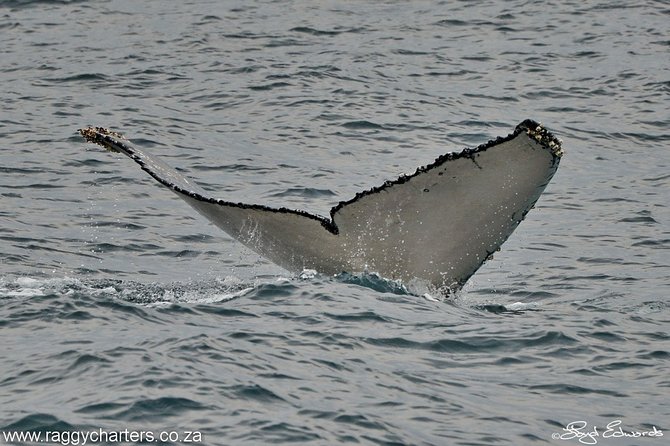
Whale season begins in June, when humpback whales move along the coast toward breeding grounds farther up Africa’s east coast. They can be seen in Algoa Bay from June through early December, with returning females sometimes accompanied by calves from October onward.
That seasonal detail helps you judge the tour fairly. If whales are your main goal, June through early December offers the best stated window, while October and November may bring the special possibility of seeing mothers with young. Southern right whales are usually seen nearer shore from July to September, adding another useful seasonal option.
The boat does not promise a whale encounter, and conditions can change quickly. Still, the crew’s job is not simply to point at a distant fin. They explain the animals’ movements and behavior, helping you understand why a whale is in the bay and what you are watching.
The strongest whale sighting described from this cruise was a mother and baby humpback. That kind of encounter is never something you can schedule, but the slow pace gives the boat time to stay with a sighting when conditions allow.
You may also see Bryde’s whales or minke whales. These are possibilities rather than guarantees, so I would treat the broader species list as a bonus, not as a checklist.
Dolphins beside the bow
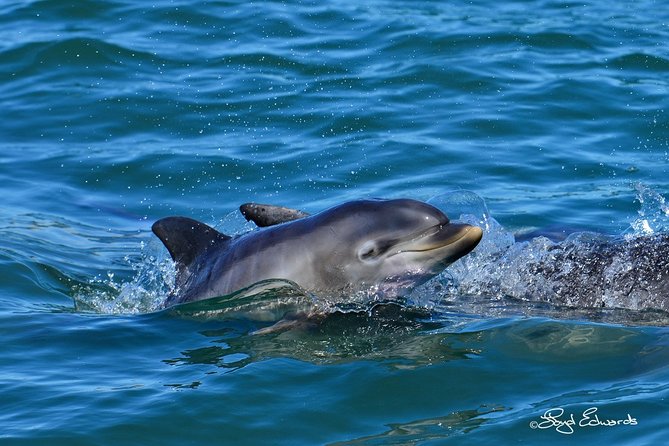
Dolphins are the most reliable wildlife possibility on this cruise. Indo-Pacific bottlenose dolphins are seen throughout the year, often in groups ranging from 10 to 400. They favor shallow water near beaches and around St. Croix Island, and they may come close to the boat to ride the bow waves.
This can be the most lively part of the trip. Instead of watching a whale surface once in the distance, you might have dolphins moving alongside the catamaran for an extended period. The crew can help you notice differences in movement, group size, and feeding behavior.
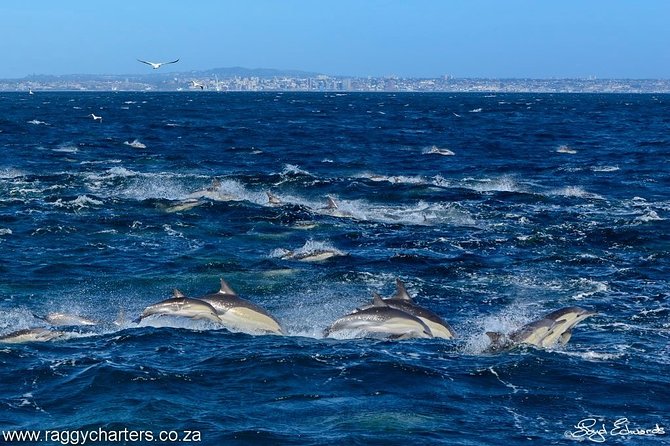
Common dolphins are another possibility. They are often found farther offshore in groups of 1,000 to 2,000, moving fast as they follow shoals of baitfish. If the boat encounters one of these groups, the scale of the sighting can be remarkable, though fast-moving dolphins are harder to photograph than the slower bottlenose groups near the island.
Humpback dolphins also occur in Algoa Bay. The available information does not provide a firm sighting season or frequency for them, so again, consider them an extra possibility rather than a central promise.
I like that the cruise is designed around observation rather than speed. A fast boat can cover more water, but a slower approach gives you more time to watch dolphins without turning the encounter into a quick pass-by.
St. Croix Island and its African penguins
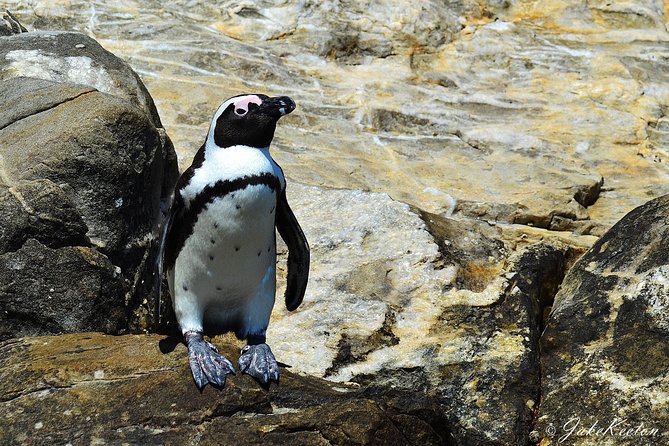
St. Croix Island is the main penguin stop. The island is home to an African penguin breeding colony described as numbering around 12,000 birds, although the population has lost 70 percent in a decade. That contrast is important. You are seeing a major colony, but also a species under serious pressure.
The penguins are viewed from the boat, not on a walk around the island. You may see them resting on the rocks, gathering near the water, or swimming out to feed. Their breeding season reaches its peak from March through May, when you may be able to spot chicks from the catamaran.
The distance and conditions affect what you see. Penguins are small, and a bird on a rock will not fill your view the way a dolphin beside the boat can. Bring a camera with a useful zoom if you want close photographs, and listen to the crew’s descriptions to understand what is happening when the birds are spread out.
One practical point deserves attention: a recent outing described seeing fewer penguins than expected, with overfishing cited as part of the problem. That is not a reason to skip the island. It is a reason to approach the sighting with realistic expectations and to value the conservation explanation as much as the photograph.
The St. Croix Island group and Bird Island group form part of Addo Elephant National Park. Rangers patrol the protected area, adding support for the islands and their wildlife. The cruise connects a scenic outing with a clear conservation lesson, which makes the penguin stop more meaningful than a simple photo opportunity.
More penguin colony visits:
- Port Elizabeth Adventure: Tuk-Tuk, Penguins, & Cape Recife
★ 4.5 · 9 reviews - Cape Town: Cape of Good Hope & Penguins Day Tour with Pickup
★ 4.7 · 3,362 reviews - Cape Point and Boulder’s Penguins Full Day Tour
★ 5.0 · 3,118 reviews - From Cape Town: Cape Point & Boulders Beach Full-Day Tour
★ 4.8 · 3,032 reviews
Seabirds, seals, and possible sharks
The marine wildlife list extends well beyond the headline animals. Around St. Croix and Brenton Island, you may see white-breasted cormorants, Cape cormorants, and African black oystercatchers. Cape gannets and pelagic birds such as terns, petrels, skuas, shearwaters, and albatrosses may appear farther out.
This variety makes the trip worthwhile even when whales stay hidden. The boat is moving through an active marine ecosystem, and the crew can point out birds following baitfish or resting near the islands.
Cape fur seals are another possibility. They may be seen in the water or resting on rocks, and they add a different kind of close wildlife moment to the trip. Sharks have also been spotted, including a hammerhead on one particularly fortunate outing, but you should not book this as a dedicated shark trip.
The same applies to the birdlife. The cruise may offer a strong range of species, but the exact mix depends on weather, food sources, season, and luck. I appreciate that the experience leaves room for discovery instead of narrowing the trip to one promised animal.
What the crew adds to the cruise
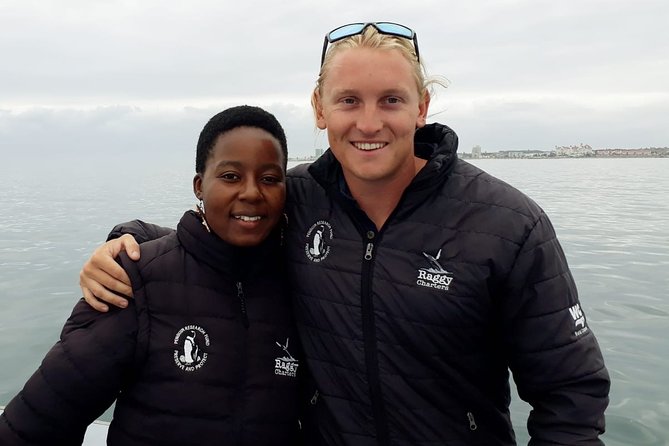
The crew is central to the experience. Their role is not just to steer the boat and point toward wildlife. They explain the bay’s ecosystem, animal behavior, and conservation problems, including the pressure on African penguins.
Jake is specifically praised for sharing detailed information and helping make the voyage memorable. The four-person crew is also described as helpful, attentive, and strongly committed to the animals. That combination matters on a small boat, where the quality of the commentary shapes much of the morning.
You can ask questions as sightings develop. Why are the dolphins staying in shallow water? Why are the penguins moving toward the sea? What is the difference between a humpback and a southern right whale? A good guide turns those moments into useful understanding rather than a string of animal names.
Safety also receives strong attention. The crew gives a briefing before departure, provides life jackets for all ages, and manages the boat carefully in rougher conditions. The activity welcomes people who can board with assistance from family and crew, though you should make your own decision based on your health and fitness.
Is the $185.19 price good value?
At $185.19 per person, this is not a cheap harbor ride. You are paying for a four-hour wildlife outing, a small group, a specialist crew, and access to a bay where several marine species may be seen in one morning.
The price looks stronger if you value time on the water and personal attention. A maximum of 20 people means you are not one face in a crowd, and the once-daily schedule keeps the experience from feeling like a high-volume operation. The tree-planting campaign also shows an effort to address the cruise’s environmental cost, although it does not remove the impact of boat travel altogether.
One useful comparison comes from the cruise setting. Booking this outing directly can cost much less than taking a similar boat excursion arranged through a cruise ship, even when the same boats are used. If you are arriving by ship, check your own port schedule and allow enough time to reach the meeting point and return safely.
The value depends on what you want. If you need guaranteed whale sightings or a low-cost penguin visit, this may feel expensive. If you want a carefully guided marine experience with a real chance of seeing dolphins, penguins, whales, and seabirds, the cost is easier to justify.
Weather, comfort, and photography
The cruise requires good weather, and poor conditions can lead to a new date or a full refund. That policy is sensible for a small boat operating in open water, but it also means your schedule needs some flexibility.
Rain does not always ruin the morning. One outing took place in heavy rain and still produced dolphins and penguins, with the crew keeping the experience enjoyable. Even so, bad weather can reduce visibility, make photography harder, and make the ride less comfortable.
Dress for exposure to wind and spray. The supplied details do not specify clothing or equipment, so I would not assume that waterproof outerwear, food, or drinks are provided. Bring the camera you can handle safely on a moving boat, and keep expectations realistic about sharp wildlife photographs.
The boat is clean and well maintained according to the information provided. Life jackets are available for all ages. There is no age restriction, but you should consider your own comfort with a four-hour boat ride and boarding with assistance if needed.
Who should book this experience?
I would choose this cruise if you want a compact introduction to Algoa Bay’s wildlife and prefer a small group over a large sightseeing boat. It suits families, photographers, bird watchers, and anyone who enjoys learning about conservation while looking for animals.
It also works well for visitors with only one morning available in Port Elizabeth or Gqeberha. You meet at 8am, spend about four hours on the bay, and finish where you started.
I would think twice if motion on the sea is a serious concern, if you need a guaranteed sighting, or if your schedule cannot handle a weather-related change. The trip is built around natural conditions, not a fixed animal show.
The strongest reason to book is the mix: bottlenose dolphins may approach the bow, humpback whales pass through seasonally, penguins gather on St. Croix Island, and the crew adds context at every stage. You are not guaranteed a perfect wildlife day, but you are given a well-planned chance to see the bay as a living ecosystem.
Should you book the Whale, Dolphin and Penguin Island Cruise?
Yes, if you want a small, conservation-minded boat trip and can accept the uncertainty of wildlife watching. The excellent satisfaction record, attentive crew, clean catamaran, and repeated praise for safety all support the booking.
For the best whale odds, consider June through early December, with July to September useful for southern right whales and October onward offering a chance of humpback mothers with calves. For penguin chicks, March through May is the key period.
Book this when you want more than a quick animal sighting. The lasting value is the combination of time on the water, expert interpretation, and a direct look at the conservation pressures facing Algoa Bay. Cancel at least 24 hours before departure for a full refund. If the weather is poor or the minimum number is not met, you will be offered another date or a refund.
FAQ
Where does the cruise depart?
The cruise departs from Nelson Mandela Bay Yacht Club, at Dom Pedro Jetty in Port Elizabeth Harbour, Gqeberha Central, Gqeberha, 6001, South Africa.
What time does the experience begin?
You meet the crew at 8am. The boat returns to the same meeting point after the cruise.
How long does the cruise last?
The experience lasts approximately four hours.
How many people can join the boat?
The maximum group size is 20 people.
What wildlife might I see?
Possible sightings include humpback whales, southern right whales, Bryde’s whales, minke whales, bottlenose dolphins, common dolphins, humpback dolphins, African penguins, Cape fur seals, sharks, cormorants, Cape gannets, and several pelagic bird species.
When is whale season in Algoa Bay?
Humpback whales can be seen in Algoa Bay from June through early December. Southern right whales are generally seen close to shore from July through September.
When might I see African penguin chicks?
The African penguin breeding season reaches its peak from March through May, when chicks may be visible from the boat.
Is the cruise accessible to people with disabilities?
People who can board with assistance from family and crew are welcome to join. You should decide if the activity suits your own health and fitness.
What happens if the cruise is canceled because of weather?
If poor weather causes cancellation, you will be offered a different date or a full refund. You can also cancel up to 24 hours before the start time for a full refund.
More dolphin trips from Port Elizabeth & Addo
- Cape Town: Dolphin & Ocean Wildlife Kayaking Adventure ⚓️
★ 5.0 · 57 reviews - Plettenberg Bay: Dolphin and Marine Boat Tour
★ 4.5 · 45 reviews - Durban: Durban: Whale and Dolphin Watching Boat Tour
★ 4.7 · 45 reviews
More whale watching from Port Elizabeth & Addo
- Hermanus: Boat Based Whale Watching Experience
★ 4.4 · 1,180 reviews - Hermanus: Whale and Dolphin Watching Boat Trip
★ 4.6 · 807 reviews - From Cape Town: Hermanus Whale Watching Boat Trip
★ 4.4 · 378 reviews - Plettenberg Bay: Whale Watching Boat Cruise
★ 4.4 · 362 reviews
Just listed around Port Elizabeth & Addo
- Township Experience – Port Elizabeth★ 5.0 · 5 reviews
- Schotia Private Game African Safari Guided Tour★ 5.0 · 5 reviews
- Ultimate Port Elizabeth Tour★ 4.5 · 5 reviews
- Addo River Safari – Guided Tour via Canoe★ 4.6 · 6 reviews
- Half-Day Addo Elephant National Park★ 4.5 · 6 reviews
- Addo: Game Drive in Addo Elephant National Park Private★ 4.5 · 6 reviews
- Sunrise Safari – through Addo Park to Schotia reserve★ 4.5 · 6 reviews
- Big 5 Tour from Port Elizabeth★ 3.5 · 7 reviews
Penguin Colony Tours, compared.
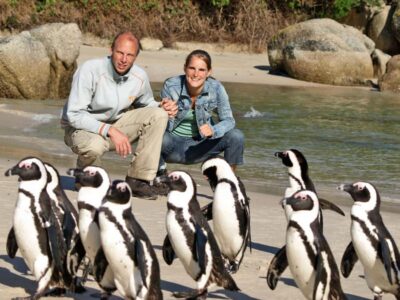
Cape of Good Hope & Penguins Day Tour with Pickup
Read our review →
Cape Point and Boulder’s Penguins Full Day Tour
Read our review →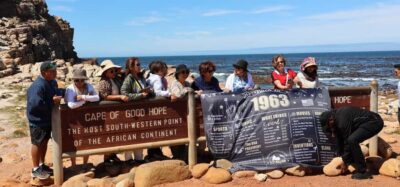
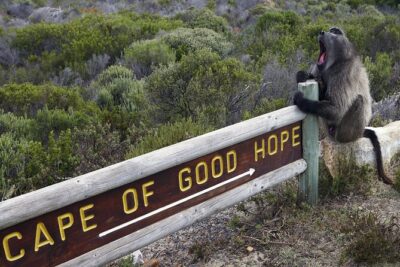
Cape of Good Hope & Boulder Penguins Full-Day Tour from Cape Town
Read our review →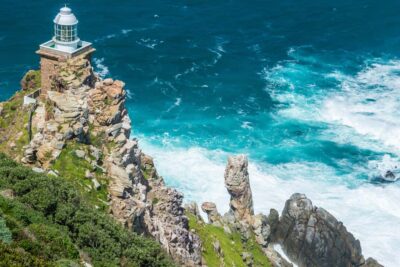
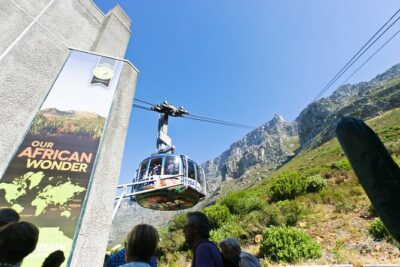
Table Mountain, Penguins & Cape Point Small Group Tour Cape Town
Read our review →
Cape Town Tour: Table Mountain, Penguins & Cape Point+Pickup
Read our review →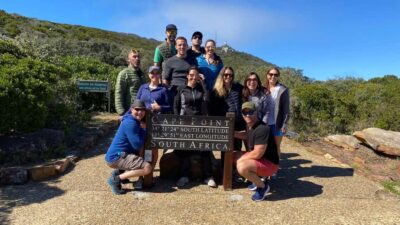
Table Mountain, Cape Point, & Penguins Group Tour
Read our review →Browse the lists this tour appears in