
Reviewed · CITY TOURS
Pretoria City Tour
Pretoria’s story is not tidy, and that is exactly what makes this tour worthwhile. In four to five hours, you move from Boer migration at the Voortrekker Monument to the modern democratic message of Freedom Park, with the Union Buildings and Church Square filling in the middle.
I like the private format, since guides such as Lesiba and Martin can adjust the conversation to your interests. I also like the range of stops: grand government buildings, a historic city square, memorials, and a museum-style heritage site all appear in one morning or afternoon.
The main drawback is cost. At $108.52 per person, this is not a cheap city transfer, especially because admission fees and taxes are extra. You are paying for private transport, a guide, and a focused introduction to Pretoria rather than a simple sightseeing shuttle.
Key points before you book
- A private Pretoria tour from Johannesburg: Your group travels in an air-conditioned vehicle, with no unrelated passengers joining you.
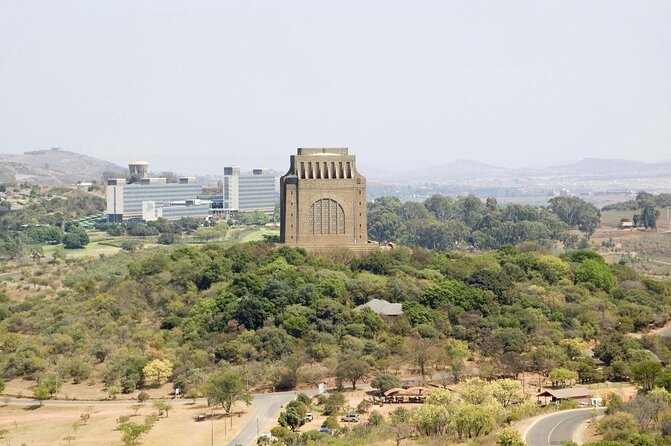
- The Voortrekker Monument anchors the day: Plan on about an hour for a guided look at the monument and the story of the Great Trek.
- Freedom Park gets the most time: Its two-hour visit connects South Africa’s wars, apartheid, and the struggle for human rights.
- Guides can shape the history lesson: Lesiba and Martin are praised for clear explanations, balanced discussion, and adapting to personal interests.
- The price covers transport, not everything: Bottled water and private transportation are included, while entrance fees, lunch, drinks, and taxes are not.
- Expect a serious, history-led outing: Pretoria’s architecture and memorials matter more here than shopping, food, or casual city wandering.
Why Pretoria makes a useful half-day from Johannesburg
Pretoria, also called Tshwane, is South Africa’s administrative capital. Cape Town handles the legislature, Bloemfontein is the judicial capital, and Pretoria houses the national government and many foreign embassies.
That distinction gives the city a different feel from Johannesburg. The tour is less about contemporary city energy and more about how South Africa was shaped by migration, colonial power, war, apartheid, and democracy.
The city’s nickname, Jacaranda City, comes from the purple jacaranda blossoms that appear in spring. You may notice the trees during the drive, but this experience is not built around gardens or seasonal scenery. Its real subject is politics and memory.
I would choose this tour if you want context. Pretoria can seem quiet or plain when seen only from a vehicle, but the right guide gives meaning to the buildings and monuments. Lesiba is especially good for visitors interested in Afrikaans development and the Boer experience, while Martin is praised for bringing the historical material to life in a friendly, clear way.
A few more Johannesburg days worth comparing
- From Johannesburg: Pilanesberg Nature Reserve Game Safari
★ 4.8 · 1,327 reviews - Johannesburg: Hop-On Hop-Off Bus with Optional Soweto Tour
★ 4.6 · 985 reviews - Soweto /Johannesburg and Apartheid Museum Guided Full Day Tour
★ 5.0 · 932 reviews
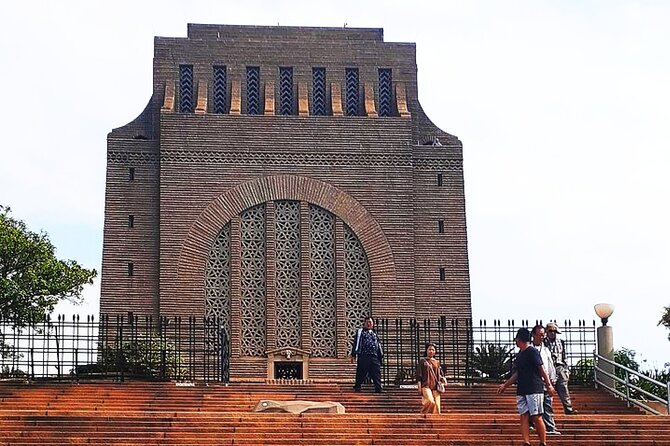
The Voortrekker Monument and the Great Trek
The first major stop is the Voortrekker Monument, with about an hour set aside for a guided visit. Admission is not included, so check the extra entrance cost before booking.
The monument tells the story of the Voortrekkers, Dutch-speaking settlers who left the Cape during the 1830s and 1840s. The tour description places special attention on the movement from the Cape into the interior, particularly the years 1836 and 1837.
This is the place where a guide matters most. The monument is tied to Afrikaner identity, the Great Trek, battles, settlement, and the later political story of South Africa. A bare walk through the site can leave you with dates and names but little sense of why the monument carries such emotional weight.
Ask your guide to explain how the Voortrekker story was presented in the past, and how it fits into a wider account that also includes African communities, colonial expansion, and later conflict. Lesiba has been especially effective when the focus turns to Boer history and the development of Afrikaans.
The monument is not a light sightseeing stop. It asks you to think about competing versions of the past. That makes it valuable, but some people may find the patriotic tone demanding or one-sided if it is not placed in a wider setting. The guide’s ability to give balance is a major part of the experience.
Church Square at Pretoria’s historic center
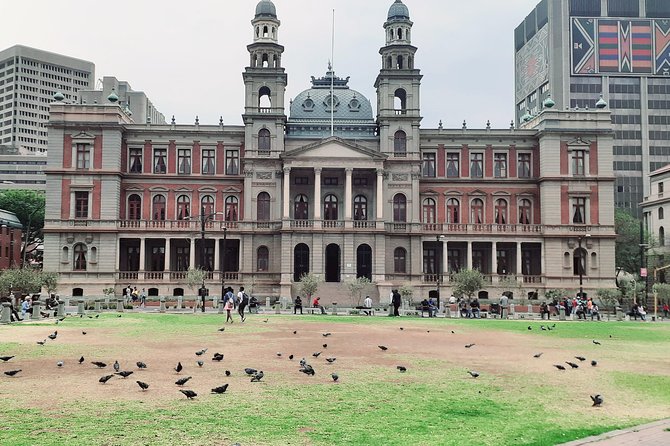
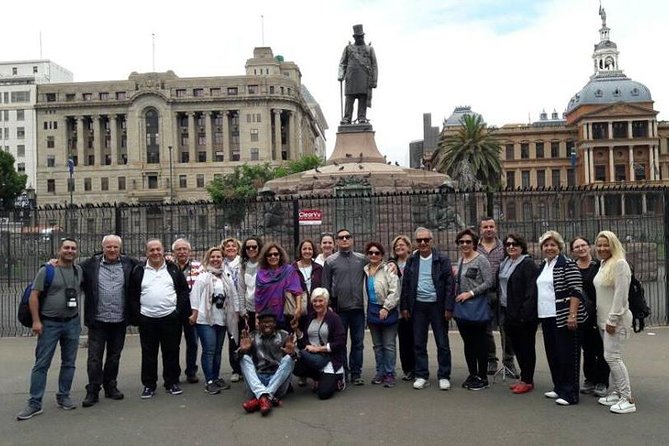
Church Square takes about 30 minutes and has no admission charge. It is the old center of Pretoria, founded by Marthinus Pretorius, who designated the area as a market and church yard.
The square took its present name from the church buildings that occupied its center between 1856 and 1905. Its buildings and monuments help you read the city as a former Boer capital, rather than simply as a modern government center.
Thirty minutes is enough for an introduction and photographs, but not a full architectural study. You will likely hear how the square developed and why it mattered to early Pretoria. If you enjoy urban history, use this stop to ask about the relationship between the square, the surrounding government buildings, and the city’s changing political identity.
The limitation is simple: this is a short orientation stop. It is not a long walking tour through every street or building. Still, after the Voortrekker Monument, it provides a useful shift from the interior story of migration to the civic center built by the new settlement.
The presidential residence and Pretoria’s early institutions
The itinerary also refers to the presidential residence, a house that was the first in Pretoria to receive electric lighting. The property contains original furnishings or pieces from the same period, giving the visit a domestic angle rather than only a grand political one.
A curious detail is the building method. Milk was used in place of water to mix the cement because the available cement was poor quality. That small fact helps make the past feel practical and human. It is the kind of detail a good guide can use to break up a long series of political names and dates.
The tour also passes or visits points connected with the University of South Africa, commonly called Unisa. Founded in 1873 as the University of the Cape of Good Hope, it later became a distance-learning institution and grew into one of the largest university systems in Africa, with more than 300,000 students and students from about 130 countries.
That stop is useful if you want to understand Pretoria as an academic city. The capital has three universities, along with major research bodies including the Council for Scientific and Industrial Research and the Human Sciences Research Council. These institutions help explain why Pretoria is more than a government town.
The details of the Unisa stop are not fully specified, so treat it as part of the city overview rather than a guaranteed extended campus visit.
A different side of Johannesburg altogether:
- Johannesburg Hop-On Hop-Off City Tour with Soweto Option
★ 4.5 · 768 reviews - Full Day Ultimate Pilanesberg National Park Safari from Johannesburg or Pretoria
★ 4.5 · 718 reviews - Half-Day Tour of Soweto Tour
★ 4.5 · 712 reviews - Soweto: Walking Tour with a Local Guide and Lunch
★ 4.9 · 648 reviews
Union Buildings and the seat of government
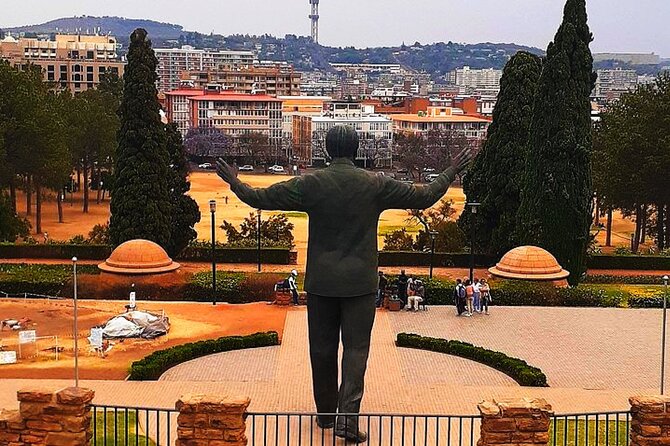
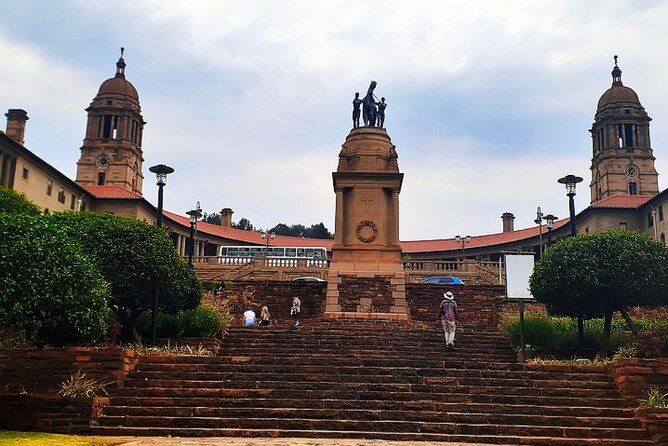
The Union Buildings receive about 45 minutes, with no admission fee. They sit on Meintjieskop at one of Pretoria’s highest points and serve as the official seat of South Africa’s government. The offices of the president are here as well.
Designed by architect Sir Herbert Baker in light sandstone, the buildings have the formal scale you would expect from a national seat of power. Their position above the city also makes them one of the best places on this tour for broad views over Pretoria.
This is a good point to connect architecture with politics. The buildings represent the government of an earlier South Africa, but they now serve the democratic state. That tension is central to understanding the capital.
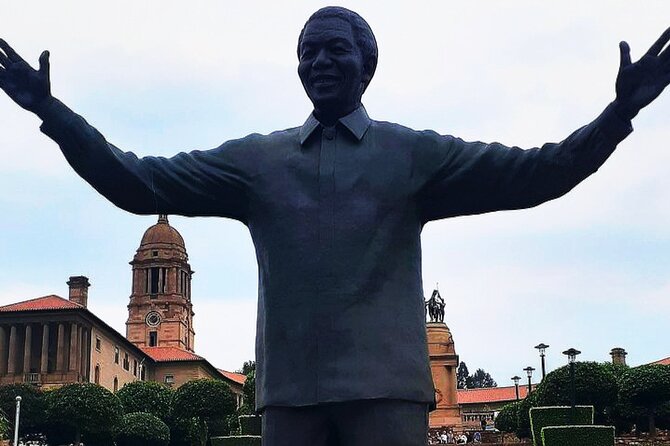
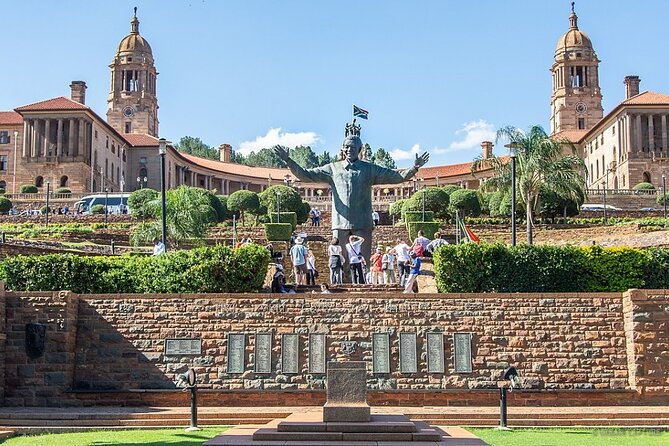
The grounds also contain a large statue of Nelson Mandela, and the visit can carry real emotional weight. Give yourself time to look beyond the building’s symmetry and ask what it means for a site once associated with minority rule to now house the government of a constitutional democracy.
The 45-minute stop should be enough for the main view, the buildings, and an explanation from your guide. It is not enough for a detailed interior tour, and the information provided does not promise entry into government offices. Think of it as an exterior visit and a historical viewpoint.
Freedom Park on Salvokop Hill
Freedom Park is the longest stop, with about two hours planned. Admission is not included, so add that cost to your budget.
This heritage site and museum is devoted to freedom and human rights in South Africa. It includes memorial spaces and a list of people killed in the South African Wars, the First and Second World Wars, and the apartheid era.
That broad scope makes Freedom Park an important counterpoint to the Voortrekker Monument. The earlier stop centers on one community’s account of migration and nation-building. Freedom Park widens the frame to include many periods of conflict and the human cost of the country’s political past.
The visit can be moving, particularly when you take time with the names and memorials. It is not simply a place for quick photographs. Two hours gives your guide room to explain the site and gives you time to absorb it without rushing from one display to the next.
If you prefer light sightseeing, this may feel heavy. If you want an honest introduction to South Africa’s past, it is probably the most important stop of the day. Ask questions, especially if you want to understand how the South African Wars, world wars, and apartheid are linked in the park’s presentation.
Fountains Valley and Pretoria’s older roots
The route also includes information about Fountains Valley, a recreational resort at Pretoria’s southern entrance. The area was proclaimed a nature reserve by President Paul Kruger in 1895. Along with nearby Groenkloof Nature Reserve, it forms part of what is described as the oldest reserve system on the African continent.
The Apies River runs through the area, and the resort has facilities including a swimming pool, caravan park, playground, lapa, and barbecue areas. Near the resort are ruins connected with Lucas Cornelius Bronkhorst, whose family belonged to Hendrik Potgieter’s Great Trek party and owned some of the first farms in the district where Pretoria developed.
The available schedule does not give Fountains Valley a separate stop length, so do not assume you will have time for a full nature walk or use of the recreational facilities. Its value is mainly as historical context. It links the city’s modern streets to the farms and trek routes that came before them.
A guide-led history lesson, not just a transfer
The strongest feature of this experience is the guide. Lesiba and Martin are repeatedly praised for being well informed, friendly, patient, and willing to tailor the day.
That flexibility matters in Pretoria. You may want to focus on Afrikaans history, the Boer republics, apartheid, Mandela, architecture, or the role of Pretoria today. A fixed audio tour cannot respond to those interests. A private guide can slow down, explain a term, or connect one monument to another.
Communication before pickup is another practical strength. Lesiba has contacted people several days ahead to confirm arrangements, which is useful when you are starting from Johannesburg and need a clear meeting plan.
The service is private, so only your group participates. That makes the $108.52 per-person price easier to justify for couples, families, or small groups who value personal attention. Group discounts are offered, but the exact discount is not specified, so ask for the current rate before booking.
You receive an air-conditioned vehicle, private transportation, and bottled water. Lunch, brunch, a single drink, entrance fees, and all taxes are extra. A lunch or single drink can be added to a full-day version, but this particular experience lasts about four to five hours.
What the $108.52 price really buys
At first glance, $108.52 per person looks high for a half-day city tour. The price makes more sense if you are staying in Johannesburg and want a private round trip with a guide rather than arranging separate transport, entrance tickets, and explanations yourself.
You are buying time and structure. Pretoria’s key sites are spread out, and the historical connections are not always obvious. The guide turns several unrelated-looking stops into a story that moves from migration and settlement to government, war, apartheid, and human rights.
The price is harder to justify for a solo visitor on a tight budget, particularly when entrance fees and taxes are added. It may also feel expensive if your main goal is simply to see the Union Buildings and take photographs.
For two or more people, the private format becomes more attractive. You can ask for a slower pace, focus on a particular subject, and avoid spending a full day on a large group excursion. Before you commit, confirm the pickup area, total entrance costs, and whether any group discount applies.
Who will get the most from this tour
I would recommend it to first-time visitors who want a serious introduction to Pretoria from Johannesburg. It also suits anyone with a specific interest in South African politics, Afrikaner history, the Great Trek, apartheid, or the transition to democracy.
It works well for couples and small groups who prefer a private guide. Families with older children may also appreciate the clear structure, though Freedom Park and the Voortrekker Monument deal with difficult subjects.
You may want something else if you are looking for cafés, markets, nightlife, shopping, or long unplanned walks. Pretoria is presented here through monuments, institutions, and memorials. One rating included the fair criticism that Pretoria itself may not strike everyone as beautiful, even though the historical background made the visit worthwhile.
Wear comfortable shoes and keep your schedule flexible enough for the two longer heritage visits. Since admission is extra, carry room in your budget for both the Voortrekker Monument and Freedom Park.
Should you book the Pretoria City Tour?
Book it if you want the administrative capital explained, not merely photographed. The combination of the Voortrekker Monument, Union Buildings, Church Square, and Freedom Park gives you a useful four-part view of South Africa’s past and present.
I would especially choose it with Lesiba or Martin if available, since the guide’s skill is central to the experience. Their ability to explain Boer history, Afrikaans identity, war, apartheid, and democracy in a balanced way can make the difference between a string of monuments and a meaningful day.
Skip it if you want a low-cost sightseeing ride or a relaxed city stroll. For everyone else, the private vehicle, bottled water, pickup option, and focused historical route offer solid value, provided you remember that admission fees and taxes are additional.
FAQ
Where does the Pretoria City Tour take place?
The tour is based in Johannesburg and visits Pretoria, also known as Tshwane, South Africa’s administrative capital.
How long does the tour last?
The experience lasts approximately four to five hours.
Is pickup offered?
Yes. Pickup is offered as part of the experience, and the tour provider may contact you in advance to confirm pickup arrangements.
Is this a private tour?
Yes. Only your group participates, and private transportation is provided in an air-conditioned vehicle.
Which main sights are included?
The main stops are the Voortrekker Monument, Church Square, the Union Buildings, and Freedom Park. The route also includes information connected with the presidential residence, Unisa, and Fountains Valley.
Are entrance fees included?
No. Admission to the Voortrekker Monument and Freedom Park is not included. All fees and taxes are also listed as extra.
Is food included?
No. Lunch, brunch, and drinks are not included. A lunch or single drink can be added to a full-day tour.
Can I cancel for a full refund?
Yes, if you cancel at least 24 hours before the experience start time. Cancellations or changes made less than 24 hours before departure are not accepted for a refund.
Just listed around Johannesburg
- Constitutional Hill and Soweto 5 hours tour.★ 5.0 · 5 reviews
- 5 Day Kruger Glamping Safari and Panorama Tour★ 5.0 · 5 reviews
- Cradle of Humankind and Maropeng Day Tour from Johannesburg★ 4.0 · 5 reviews
- Johannesburg: Hot Air Balloon Flight★ 5.0 · 5 reviews
- Half Day Soweto and Apartheid Museum Guided Tour★ 5.0 · 5 reviews
- Lion park★ 4.5 · 5 reviews
- 5 Day Kruger National Park and Panorama Route Safari★ 4.5 · 5 reviews
- Pretoria Historical Tour★ 4.0 · 5 reviews
City Tours, compared.
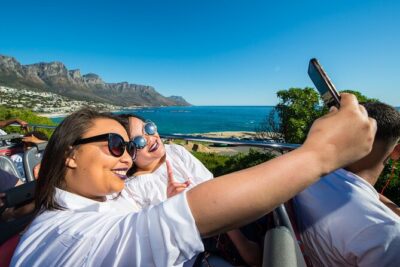
Cape Town Hop-On Hop-Off City Tour with Optional Cruise
Read our review →

Johannesburg Hop-On Hop-Off City Tour with Soweto Option
Read our review →
Jo’berg in 1 Day: Soweto, Apartheid Museum & City Tour
Read our review →
Cape Town City Pass: Save Over 50% on 80+ Top Attractions
Read our review →
Hop-On Hop-Off Bus, City Tour and Apartheid Museum
Read our review →
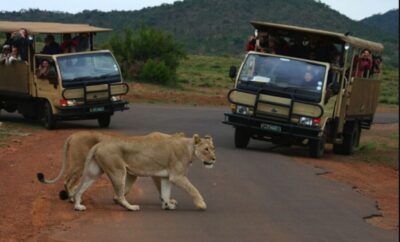
From Sun City: Pilanesberg National Park 3-Hour Game Drive
Read our review →Browse the lists this tour appears in