
Reviewed · HERMANUS & GANSBAAI TOURS
Sunset Fatbike Dune Experience
The best part of this experience is the change in scenery: you begin near Grootbos, pedal through fynbos, then ride down great sweeps of sand from about 185 meters above sea level to the beach. It is not a standard bike tour. It feels part nature outing, part gentle thrill ride, with whale watching possible in season.
I like the small-group size, capped at 10, and the way Dave mixes bike coaching with stories about dune plants, animal tracks, and the reserve. I also like that you get free photos and videos, so you can focus on the ride instead of stopping to manage your camera.
The main consideration is physical effort and comfort with sandy, steep terrain. The route has easier options around the biggest dunes, but you still need moderate fitness and basic bike-riding ability. Bring a snack if you need one, because only water is provided.
Key points at a glance
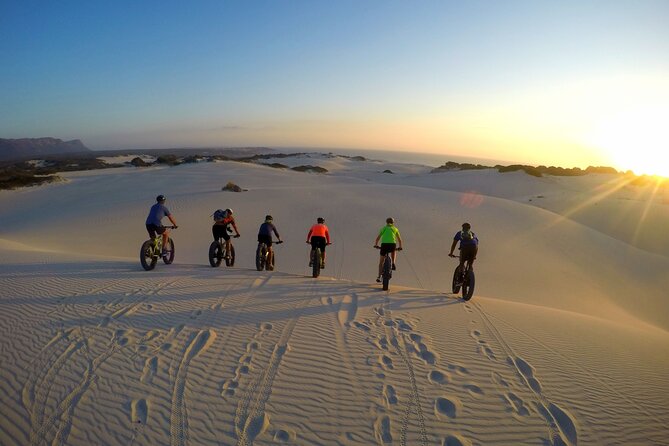
- A 6-kilometer descent to the sea: The route moves from mountain and fynbos trails to broad dunes, then along a 4×4 path toward the beach.
- Controlled thrills on soft sand: Dave teaches you how to slalom and descend steep dune faces, while easier lines are available around the largest drops.
- A small group capped at 10: This keeps the ride personal and gives you more room to ask questions or choose your preferred level of challenge.
- Nature comes with the fun: Look for animal tracks and learn about dune structure, plants, and wildlife in Walker Bay Nature Reserve.
- Sunset and possible whale watching: The late start is designed for evening light, with whale sightings possible during whale season.
- A useful all-in price: At $72.15 per person, the fee includes the bike, water, guide, reserve fees, transport uphill, and photos and videos.
From De Kelders to the top of the dunes
You meet at Fatbike Tours, 61 Ingang Street, De Kelders, Gansbaai, at 4:00 pm. The activity returns to this same meeting point, although the ride itself finishes at the beach before transport brings you back.
That uphill transfer matters. You do not have to spend the opening part of the outing grinding up a long road or sandy slope. Instead, you are taken to the top of the dune route and save your energy for the interesting part: moving across the reserve and down toward the coast.
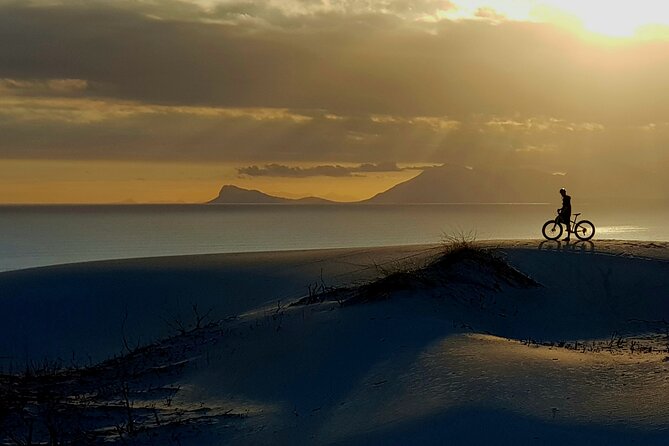
The exact amount of daylight depends on the season, so a 4:00 pm start will not always produce the same sunset timing. Still, the afternoon departure gives the outing its name and its appeal. The lower sun should bring changing color and longer shadows across the dunes, and the final beach section is timed around the most photogenic part of the day.
The experience is advertised as about two hours and 30 minutes, while the riding description gives roughly 120 minutes from start to finish. I would plan on about two to two and a half hours, without scheduling anything immediately afterward. Small changes in weather, group pace, and stops for nature commentary can affect the timing.
More evening outings in Hermanus & Gansbaai:
- Cape Town: Lion’s Head Sunrise or Sunset Hike
★ 5.0 · 1,084 reviews - Cape Town: Sunset Champagne Cruise
★ 4.6 · 1,083 reviews - Cape Town: Lion’s Head Sunrise/Sunset Hike
★ 5.0 · 921 reviews
The fynbos trail sets the pace
The first riding section follows a narrow sandy horse trail through fynbos. This is a useful introduction because it gets you used to the fat bike before the route becomes more exposed and steep.
Fynbos is a major part of the Cape environment, and Dave uses the ride to explain the plants and animals around you. This keeps the outing from becoming only a succession of downhill runs. You are learning how the reserve works as you pass through it, with stops for local stories, animal signs, and details about the dune system.
The trail is narrow, so you should expect a more focused ride than a wide, open cycle path. The supplied information calls for moderate fitness, but it also makes clear that you do not need advanced cycling skills. If you can ride a bicycle, you should be able to learn the basics of the fat bike during the briefing and warm-up sections.
That said, confidence matters. Sandy trails can feel less predictable than firm ground, and the terrain later becomes steeper. If you are nervous, tell Dave early. The route is designed with choices, and you do not gain anything by forcing yourself onto the most dramatic line.
The first dune view is the payoff
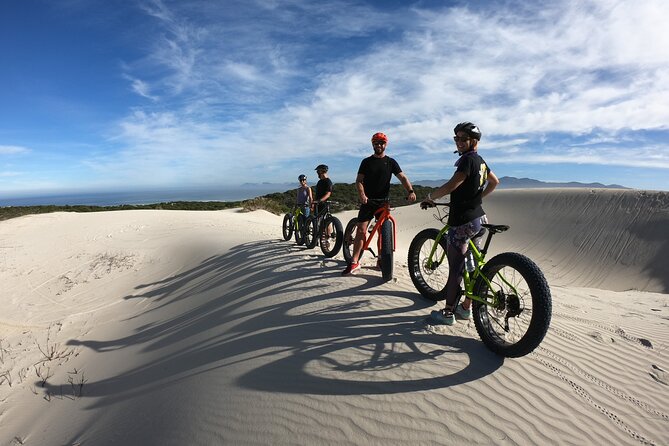
After about a kilometer on the dunes, the view opens up. This is likely the first moment when the scale of the setting becomes clear. Instead of seeing the dunes only as a cycling surface, you see their folds, ridges, and drop-offs stretching toward the coast.
Dune structure is part of the guide talk, so Dave explains more than simply where to point the front wheel. You learn how the sand forms the terrain beneath you, and you may stop to look for animal tracks. The reserve setting adds a quiet nature-study element that you would miss on a faster, purely recreational ride.
This is also where the activity becomes more visually impressive. The broad sand, coastal horizon, and late-day light give you plenty of material for photos. The guide provides photos and videos at no extra cost, including GoPro-style images according to the experience details. That is a real benefit on a moving tour, since handling a phone while riding is neither easy nor sensible.
Do not expect a wildlife safari with guaranteed sightings. You may see tracks or learn about animals that use the dunes, and whales may be visible during whale season, but nature does not follow a timetable. The value is in the setting and the interpretation, with sightings as a bonus.
Learning to ride down steep sand
The briefing before the main descents is important. A tall dune face can look far too steep when you first approach it, especially if you have never ridden a fat bike on loose sand.
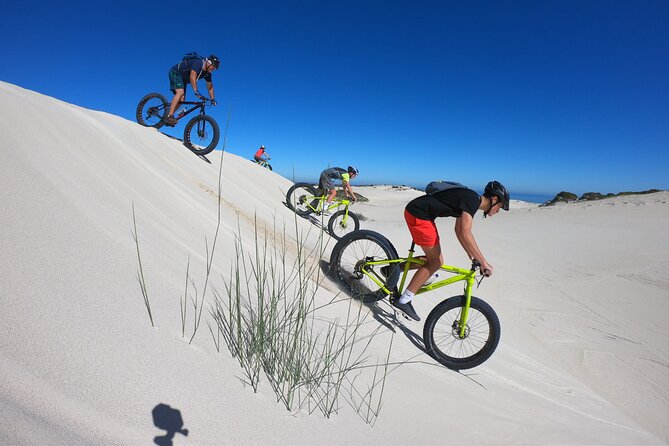
Dave teaches controlled techniques, including slalom-style turns and downhill riding. The sand helps slow the bike, and the description of the ride emphasizes that the descent is more manageable than it appears. That does not make the terrain risk-free, but it does explain why the first impression can be misleading.
You are not forced to take the biggest slope. The major dunes have routes around them, and an easier way continues down through the dunes. This makes the ride more inclusive than the dramatic photographs might suggest. Confident riders can try more adrenaline-filled sections, while cautious riders can stay with the simpler route and still reach the beach.
I would treat the choice as part of the fun, not a test. Pick the line that lets you stay relaxed and in control. A good downhill ride is one where you finish smiling, not one where you prove something to the rest of the group.
The bike itself is included in the price. Fat tires are suited to soft sand, though you still need to steer carefully and follow the guide’s instructions. The outing is described as suitable for all ages in one family account, but the formal requirement is moderate physical fitness. That means families and inexperienced cyclists may enjoy it, while very young children or anyone uncomfortable on a bicycle should think carefully before booking.
A few more Hermanus & Gansbaai days worth comparing
- Hermanus: Boat Based Whale Watching Experience
★ 4.4 · 1,180 reviews - Hermanus: Whale and Dolphin Watching Boat Trip
★ 4.6 · 807 reviews - From Hermanus or Cape Town: Shark Cage Diving Experience
★ 4.7 · 684 reviews - Whale Watching from Gansbaai
★ 5.0 · 327 reviews
Across the dunes toward the beach
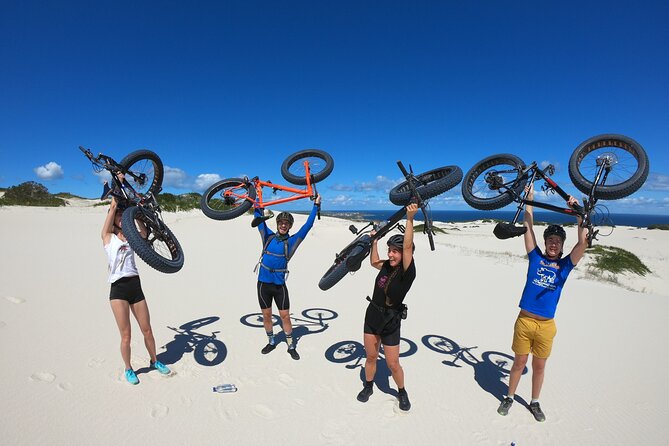
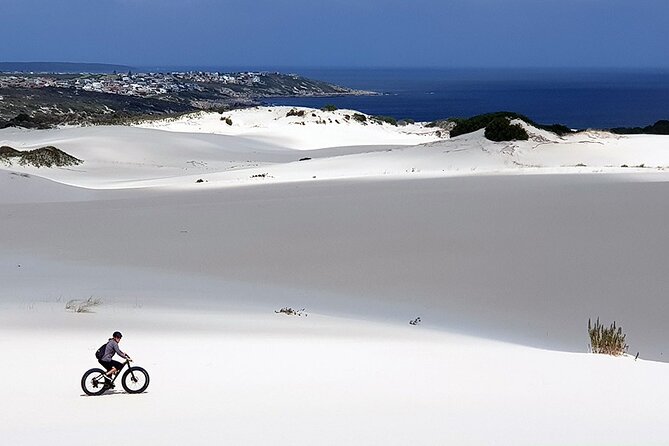
Once you have crossed the main dune section, the route changes again. You leave the sand riding for a 4×4 path down to the beach, where a vehicle meets the group.
This final transition is practical and helps keep the ride within a manageable time. You get the special part of the dune cycling without having to pedal every mile back uphill or retrace the entire route. It also gives you a clear ending point: sand under the tires, open beach ahead, and sunset light if conditions cooperate.
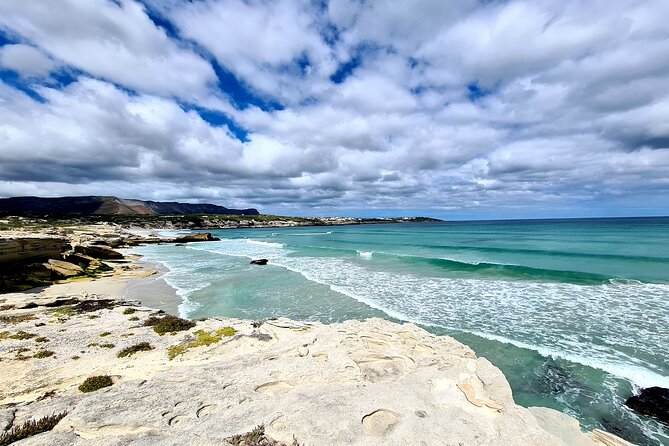
The beach is described as one of the world’s top 10 uncrowded beaches. The important point for you is not the ranking itself, but the sense of space at the finish. After riding through the dunes, arriving at a quiet shore gives the outing a proper finale rather than ending beside a road or in a parking area.
The beach stop is also where the light should be at its best. You may want a few minutes simply to look out over the water before the vehicle transfer. Do not count on a long beach visit, though. The tour is built around the ride, not a full afternoon of swimming or shore time.
Dave makes this more than a bike rental
The guide is Dave, and his role is central to the experience. He leads the ride, explains the route, gives the sand-riding briefing, and talks about the reserve’s plants, animals, history, and terrain.
His energy is a strong part of the outing. The supplied comments repeatedly praise his humor, enthusiasm, storytelling, and ability to keep people informed while moving through the dunes. That matters here because the ride includes several stops and transitions. A quiet guide could make those pauses feel like interruptions. Dave appears to use them as part of the experience.
You should expect a personal style rather than a large commercial production. The group limit of 10 supports that. With fewer people, it is easier to ask about tracks, plants, whales, or the dune formations, and easier for Dave to see how each person is managing the bike.
The guide’s passion is especially useful for people who want context. If you only want a fast downhill activity, some of the nature discussion may feel like extra time. I think it improves the outing because the dunes become more than a playground. You learn what you are riding through and why the area deserves care.
What the $72.15 price includes
At $72.15 per person, this is not the cheapest way to spend two hours in the Western Cape. The value depends on how many of the included pieces you would otherwise need to arrange yourself.
The fee covers:
- Fat tire bike
- Transport to the top of the dunes
- English-speaking guide
- Walker Bay Nature Reserve entrance and fees
- Water carried on the bikes
- Free photos and videos
The uphill transport is a particularly useful inclusion. It gives you access to a route that would be harder to organize independently, and it keeps the ride focused on the dunes rather than on a long approach.
The reserve fee and guide also add value for visitors who want more than a self-guided cycling session. You are paying for access, equipment, transport, instruction, interpretation, and a set of images from the ride. For a small group and a sunset outing, that is a fair package if the setting is a priority.
Food is not included. Only water is provided, so eat before you arrive or bring a snack if you know you will need one. The supplied details do not specify a meal stop, so do not plan on buying food during the route.
Who should book this ride
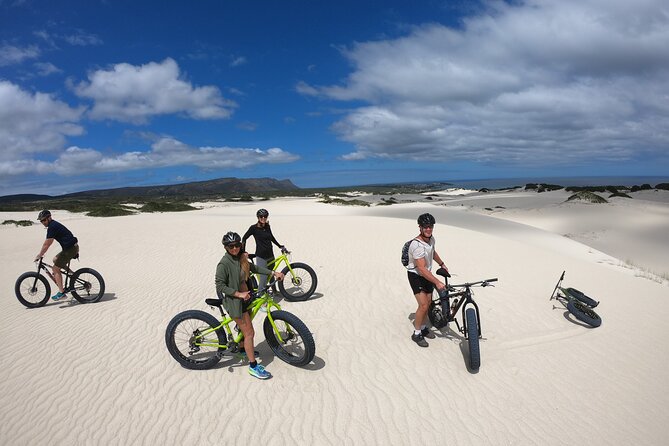
I would recommend this to you if you want an active way to see the coast and prefer something unusual to a vehicle-based outing. It suits people who like a little adrenaline but want the freedom to choose an easier route when a dune looks too steep.
It also works well for families and mixed-ability groups, within the stated moderate fitness requirement. One person can try a more challenging descent while another takes the easier path. The key is honest communication with Dave and a willingness to ride at a comfortable level.
Nature lovers should appreciate the fynbos, animal tracks, dune ecology, and possible whale watching. Photographers will benefit from the sunset light and free images. Couples and small groups looking for a memorable half-day activity may find the quiet beach finish more appealing than a crowded attraction.
I would be more cautious if you have very low fitness, cannot ride a bicycle confidently, or dislike loose sand and downhill riding. The route is controlled and offers easier options, but it remains a physical outdoor activity. Bad weather can also cancel the experience, since safe and enjoyable dune riding depends on conditions.
The maximum group size is 10, but the actual group may be smaller. Since the outing is often booked about 17 days ahead, reserve early if your Western Cape schedule is fixed, particularly if you want a specific date during whale season.
Practical details before you go
Wear clothing suited to an outdoor ride and changing coastal conditions. The information does not set out a clothing list, so use sensible riding clothes and prepare for sand, wind, and cooler evening air.
Arrive at Fatbike Tours, 61 Ingang Street, De Kelders, Gansbaai, before the 4:00 pm start. Your confirmation is issued when you book, and the activity ends back at the same meeting point after the beach transfer and return arrangements.
Water is supplied on the bikes, but snacks are not. If you have particular dietary or hydration needs, take care of them before the ride because no food stop is included.
The tour requires good weather and a minimum number of participants. If the operator cancels for poor weather or because the minimum is not met, you are offered another date or experience, or a full refund. You can cancel for a full refund up to 24 hours before the start time. Inside 24 hours, the payment is not refunded, and changes are not accepted.
Should you book the Sunset Fatbike Dune Experience?
I would book this if you want a small-group coastal adventure with real scenery, a capable guide, and a choice of easy or more thrilling dune routes. The combination of fynbos, sand riding, wildlife information, whale-season possibilities, and an uncrowded beach finish is unusual.
The strongest reason to go is that the ride gives you access to the dunes in an active, personal way. The strongest reason to hesitate is that you must be comfortable with moderate exercise and sandy descents. If that sounds manageable, the $72.15 price is reasonable for the bike, transport, reserve entry, instruction, water, and photos included.
FAQ
Where does the Sunset Fatbike Dune Experience start?
It starts at Fatbike Tours, 61 Ingang Street, De Kelders, Gansbaai, 7220, South Africa.
What time does the tour begin?
The scheduled start time is 4:00 pm.
How long does the experience last?
The tour is listed as approximately two hours and 30 minutes. The riding description estimates about 120 minutes from start to finish.
Where does the activity end?
The activity ends back at the meeting point in De Kelders.
How many people can join the tour?
The maximum group size is 10 people.
Do I need to be an experienced cyclist?
No advanced cycling experience is stated as necessary. You should be able to ride a bicycle and have a moderate level of physical fitness.
Is transport included?
Yes. Transport to the top of the dunes is included, and a vehicle meets the group at the beach before the return to the meeting point.
Is food included?
No. Water is provided on the bikes, but snacks are not included.
Can I cancel for a refund?
Yes, if you cancel at least 24 hours before the start time, you can receive a full refund. Cancellations or changes made less than 24 hours before the start are not refunded or accepted.
Just listed around Hermanus & Gansbaai
- Cape Town: Hermanus Whale Watching Shared Boat & Penguins★ 3.3 · 6 reviews
- Vineyard Safari and Wine Tasting in Hermanus with Guide★ 4.5 · 11 reviews
- Shark & Whale Trip Combo★ 4.8 · 12 reviews
- Gansbaai: Shark Cage Diving and Shark Viewing Boat Trip★ 4.9 · 14 reviews
- Big 5 Sea Safari Boat Ride of Gansbaai or Walker Bay★ 4.3 · 17 reviews
- From Cape Town: Full Day Hermanus Whale Watching Tour★ 3.6 · 20 reviews
- Hermanus Land based Whale Tour with Dave de Beer★ 5.0 · 24 reviews
- Big 5 Sea Safari in Walker Bay from Gansbaai★ 4.5 · 29 reviews
Hermanus & Gansbaai Tours, compared.
Half-Day White Shark Cage Diving from Gansbaai
Read our review →
Shark Cage Diving – Adventure Meets Conservation!
Read our review →Browse the lists this tour appears in